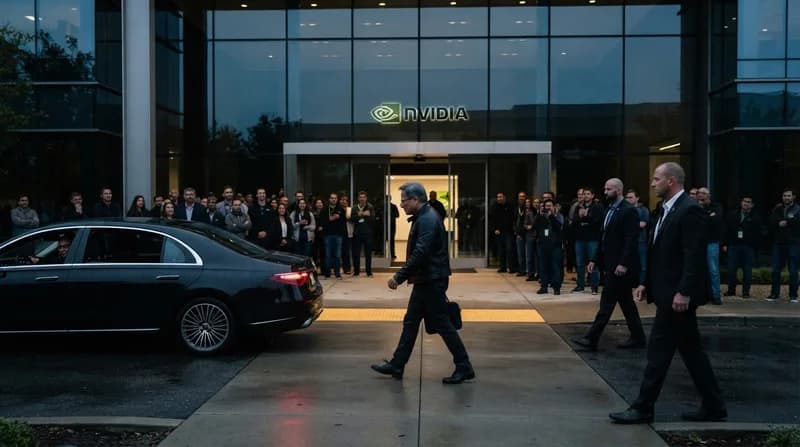
A Leadership Vacuum at the Top
The tech landscape was rocked this week as Nvidia CEO Jensen Huang stepped down following a startling resignation. The departure, triggered by revelations of an alleged affair with a contact linked to Chinese intelligence, has created a significant leadership void at the center of the artificial intelligence revolution. As Nvidia navigates this transition with interim CEO Colette Kress, the most pressing question for the industry isn't just about stock prices or hardware roadmaps—it is about the future of the open-source AI ecosystem.
For years, Huang has been the singular driving force behind Nvidia’s embrace of open-weight models and the broader open-source community. By framing open-source AI as a pillar for innovation, sovereignty, and safety, Huang successfully positioned Nvidia as the backbone for developers, nation-states, and independent research labs. His personal advocacy served as a critical counterweight to the lobbying efforts of 'frontier' labs like OpenAI and Anthropic, who have frequently pressured Washington to implement stricter regulations on open-weight technologies.
The Future of Major Acquisitions
Nvidia’s ongoing expansion into the software and platform layer is now under a microscope. The company’s proposed $13 billion acquisition of the open-source hub Hugging Face, along with a $6 billion licensing agreement for the coding platform Poolside, were marquee initiatives championed by Huang. Industry analysts are now questioning whether the incoming leadership will prioritize these deals with the same fervor, or if the company will retreat toward a more conservative, closed-off strategy.
Hugging Face CEO Clem Delangue has publicly reaffirmed the platform’s dedication to the open-source cause regardless of Nvidia's internal leadership shifts. However, the loss of an executive who personally negotiated these pacts changes the calculus. Founder-driven initiatives often lose momentum during executive transitions, and with the shadow of a national security scandal looming, there is growing apprehension that Nvidia might deprioritize its commitment to the open ecosystem to appease regulators in Washington.
Business Strategy Beyond Idealism
While Huang’s passion for open source was evident, it was also a calculated business maneuver. As major hyperscalers—such as Google, Meta, and OpenAI—continue to develop their own custom silicon, Nvidia’s long-term survival depends on fostering a massive, diverse customer base beyond the 'frontier' giants. By supporting a broad array of developers and enterprises through the Nemotron family of models and investments in companies like Reflection AI and Thinking Machines Lab, Nvidia ensured that demand for its GPUs remained high, regardless of who controlled the 'frontier' model market.
The current challenge for Nvidia is twofold: managing the geopolitical fallout of the scandal and maintaining a market strategy that makes open-source AI profitable. If the company turns inward under new leadership, it risks alienating the very developers who have built the modern AI economy on Nvidia hardware. Conversely, if it stays the course, it must navigate a Washington that is increasingly skeptical of open-source models that could potentially be leveraged by international competitors. As the industry watches, the departure of the man who arguably built the modern AI era marks a pivotal moment for the future of democratic, accessible intelligence.