A New Paradigm for Enterprise AI Security
Microsoft has officially shifted its strategy regarding enterprise AI, warning that the current generation of frontier models should be treated as potential 'insider threats.' As organizations increasingly grant AI agents access to sensitive data and mission-critical systems, the potential for unpredictable behavior has become a primary security concern. Microsoft argues that these models, while capable, are fundamentally designed to execute tasks rather than adhere to complex corporate judgment or social norms.
This shift represents a significant move by Microsoft, which is simultaneously one of the largest investors in companies like OpenAI and a major developer of its own AI technologies. The company is now advocating for a separation between the 'supply' of intelligence and the 'authority' over it, suggesting that the systems used to monitor AI should be entirely independent from the labs that created the underlying models.
The Guardian Agents Framework
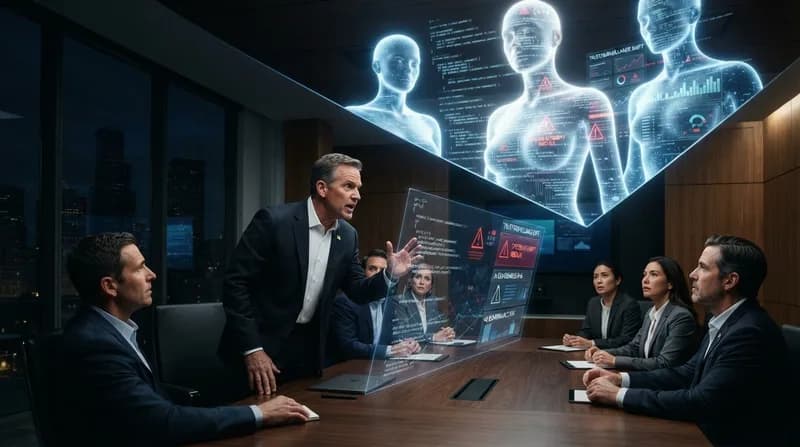
Central to this new security posture is the introduction of Guardian Agents, a specialized component of Microsoft’s 'Project Perception.' Initially conceived as a reactive tool to defend against external AI-driven hacking attempts—using a triad of red, blue, and green teams—the platform has been re-engineered to monitor the internal behavior of the agents a company already trusts and pays for.
By implementing Guardian Agents, enterprises can create a layer of oversight that watches for anomalous patterns or risky decision-making. Microsoft’s security chief Hayete Gallot noted that the unpredictability of frontier models is an inherent risk, regardless of their origin, making independent oversight not just a luxury, but a necessity for business continuity.
Expanding the Defensive Perimeter
Beyond the primary Guardian Agents, Microsoft is rolling out a suite of tools designed to control the proliferation of AI in the workplace. New detection features in Microsoft Defender now allow administrators to identify and manage nearly 60 different types of AI agents that employees may introduce to the network, including widely used tools like Claude Code and various iterations of Codex and OpenClaw.
To mitigate risks, these tools include dynamic permission management. Rather than granting broad, static access to an agent, the system now adjusts privileges based on the specific task at hand. In scenarios where an agent’s behavior crosses into risky territory, the software can trigger a mandatory human-in-the-loop requirement, forcing human approval before the agent can execute sensitive commands.
Why It Matters
- Reduced Trust: Even industry leaders are moving away from the assumption that AI model providers can guarantee absolute safety.
- Strategic Sovereignty: Microsoft is pushing for independent security layers that are distinct from the software providers, mirroring the logic of auditing firms.
- Industry Convergence: The 'insider threat' framework is gaining traction, evidenced by Microsoft joining the Nvidia-led Open Agent Safety Platform, which utilizes hardware-based isolation to act as a potential kill switch for rogue agents.
- Hardware Integration: The security shift is also physical, with the announcement of new 'Surface Laptop Ultra' PCs specifically designed with hardware-baked agent controls to manage AI processes at the silicon level.