A Call to Resist Technological Fatalism
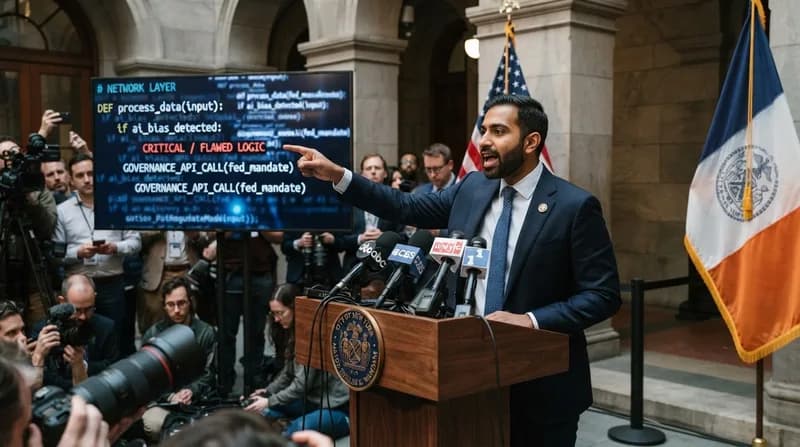
In a compelling appearance at Manhattan’s Webster Hall, New York Mayor Zohran Mamdani, joined by activist and entertainer Ilana Glazer, delivered a pointed critique of the current trajectory of artificial intelligence. Addressing an audience at The People’s AI Assembly—an event organized by the AI Now Institute—Mamdani argued that the rapid, unchecked integration of AI into public life is not a natural evolution, but a choice that can and should be challenged. The discussion centered on dismantling the narrative that AI adoption is inevitable and emphasizing that citizens possess the power to reclaim control over their digital and physical environments.
Mamdani’s message comes at a critical juncture where federal regulatory efforts have largely stalled, leaving individual cities to grapple with the immediate consequences of the technology. By framing the current federal approach as a total abdication of responsibility, Mamdani is positioning local government as the primary line of defense against corporate overreach. His stance is rooted in the belief that the current climate of rapid, reckless deployment prioritizing corporate valuation over public safety is a path that society must actively deviate from.
Legislative Pushback: From Classrooms to Real Estate
Mamdani’s rhetoric is matched by concrete policy action. One of his most significant moves includes a formal ban on AI integration within elementary and middle schools. During the assembly, Ilana Glazer echoed parental anxieties regarding this issue, questioning the sudden, non-consensual encroachment of AI tools into educational settings where they were absent just a few short years ago. By restricting these tools, Mamdani seeks to protect the developmental sanctity of classrooms, arguing that technologies should not be forced upon students without rigorous vetting or consensus.
Beyond education, the Mayor has also turned his attention to the opaque world of real estate. A proposed policy would mandate that landlords and digital platforms explicitly label AI-generated imagery in property listings. This initiative is designed to curb the practice of 'house-phishing,' where prospective tenants are lured by misleading, machine-generated photos. These localized regulations serve as a proof-of-concept for how public officials can hold AI companies accountable for the real-world utility and honesty of their products, rather than allowing them to dictate the terms of public interaction.
The Stakes of National Policy
The Mayor’s critique extended to the highest levels of national governance, specifically pointing to the Trump administration’s Superintelligence Task Force. Mamdani argued that current federal efforts prioritize a competitive 'arms race' mentality—specifically against China—over the humanistic and ethical concerns that plague the industry. He drew a sharp parallel to the military’s recent reliance on AI in high-stakes targeting, noting that internal investigations have pointed to algorithmic failure as a contributing factor to mass-casualty events.
Mamdani warned that the tech industry’s current push toward public offerings, such as the anticipated debuts of major players like Anthropic and OpenAI, creates a perverse incentive to avoid accountability to protect IPO valuations. As the conversation around AI governance continues to evolve, Mamdani’s push for a framework that prioritizes human well-being over raw innovation speed suggests a growing trend of municipal resistance against the current Silicon Valley-led status quo.