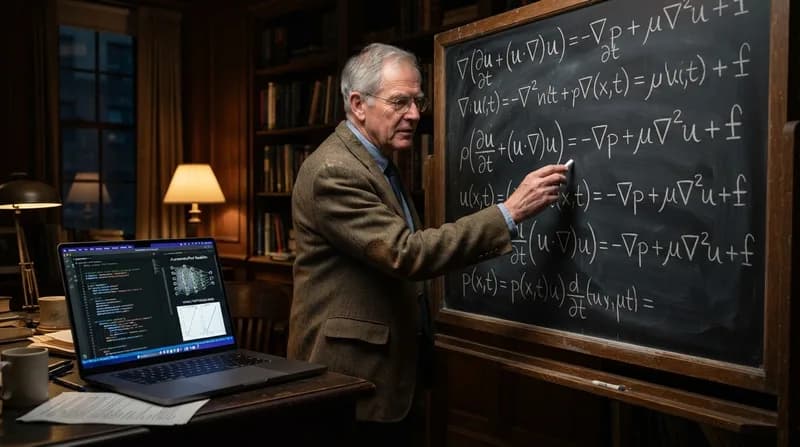
A Collision of Academia and AI Ambition
The world of theoretical mathematics has been shaken by a high-stakes controversy involving Tristan Buckmaster, a professor at NYU, and the artificial intelligence giant OpenAI. At the heart of the dispute is the Navier-Stokes existence and smoothness problem—one of the seven prestigious Millennium Prize problems, each carrying a million-dollar bounty from the Clay Mathematics Institute. The Navier-Stokes equations, which govern fluid dynamics, remain a profound mystery in theoretical physics, and their resolution would represent a monumental milestone in human knowledge.
Buckmaster, alongside Anthropic mathematician Levent Alpöge, recently announced preliminary findings on the problem, leveraging AI models like OpenAI’s Codex and Anthropic’s Claude. However, what should have been a celebration of progress has devolved into allegations of academic malpractice. Buckmaster alleges that after details of his research progress leaked to OpenAI, the company rapidly pivoted its own internal teams to target the same specific mathematical approach, utilizing massive compute resources to force a finish line before the duo could finalize their work.
The Allegations of Data Misuse
The crux of the controversy lies in the nature of AI-assisted research. Because Buckmaster relied heavily on OpenAI’s Codex model to process his mathematical work, he is concerned that his proprietary interactions may have been ingested and utilized by the lab to inform their own pursuit of the proof. OpenAI’s terms of service allow for the training of models on user interactions unless a specific opt-out is enabled, raising serious questions about whether the AI essentially 'spied' on its user to help OpenAI reach the solution first.
According to Buckmaster, communication with OpenAI leadership, specifically Sebastian Bubeck, proved evasive. The professor claims that during discussions, OpenAI pressured him to remove Alpöge’s credit from the project—potentially due to his affiliation with a rival AI lab—and warned that going public with his concerns could negatively impact his career. Bubeck has since publicly labeled these claims as "false and inflammatory," maintaining that he upheld academic standards throughout his interactions with the researchers.
Why it Matters
- The Integrity of Research: This incident forces a reckoning with how researchers use AI tools. If private, ground-breaking research can be effectively 'scraped' by the very AI platforms being used to solve it, the academic community may lose trust in using LLMs for high-level problem solving.
- The Compute Gap: The narrative highlights a growing imbalance where companies with vast compute infrastructure can potentially out-run individual researchers if they gain access to a promising direction, raising ethical questions about fair play in scientific discovery.
- Millennium Prize Stakes: With a $1 million bounty and historical prestige on the line, the drive to solve a Millennium Prize problem is immense, potentially creating incentives that clash with traditional open-science collaboration.
The Future of AI-Driven Discovery
As the debate continues, the mathematical community is left to grapple with the role of black-box models in scientific breakthroughs. Buckmaster has committed to transparency, arguing that the only way to combat the current opacity is to share the findings and the timeline of the research as widely as possible. OpenAI has yet to clarify whether their internal models were trained on Buckmaster's specific prompts, leaving the scientific community waiting for a more comprehensive statement from the company.
This dispute serves as a precursor to a larger conflict: how do we protect intellectual property when the 'brain' conducting the work is owned by the same entity vying for the patent or prize? Until clear guidelines are established regarding the privacy of AI-assisted research, the boundary between collaborative innovation and competitive theft will remain perilously thin.