Beyond Static Brain Imaging
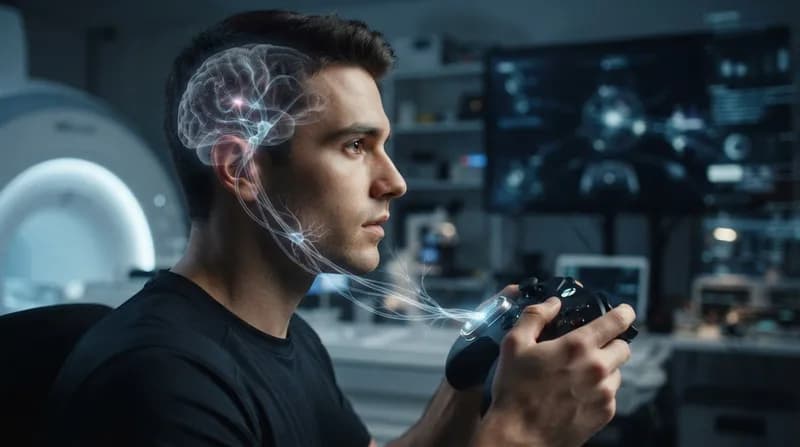
For decades, the standard for neurological research has been the "resting-state" fMRI scan, where subjects lie perfectly still, performing isolated, artificial tasks. While this has provided a foundational understanding of brain architecture, it ignores the dynamic, chaotic nature of human life. Real-world cognition is defined by a constant cycle of perception, prediction, action, and reaction. To bridge this gap, neuroscientists Jörn Diedrichsen and Jody Culham at Western University are pioneering a new approach: using immersive video games to map the brain in motion.
This initiative, part of the larger "Digital Brain Project" supported by Meta, seeks to catalog human brain activity across a vast spectrum of cognitive states. By moving away from static tasks, researchers are able to observe the brain as a complex landscape that shifts based on decisions, environmental feedback, and the continuous need to adapt to changing variables.
The "Closed-Loop" Advantage
The core philosophy of this project is the study of the "closed-loop" system—a feedback cycle where a player interacts with a virtual environment, observes the results of their actions, and modifies their behavior accordingly. Unlike traditional laboratory experiments, where a subject might simply view an image and press a button, playing a game like Pac-Man or a high-speed kart racer requires a continuous stream of predictive cognition. The brain is constantly building a model of the game world, anticipating the movement of ghosts or the physics of a turn, and updating its strategy in milliseconds.
By integrating these immersive, gamified experiences into an fMRI environment, the researchers are capturing data that more accurately reflects the brain’s true functional capacity. This approach allows them to look at the cerebellum, thalamus, and midbrain through a new lens, recognizing these areas not just for motor control, but as critical hubs for high-level prediction and cognitive processing.
Hardware Upgrades for Immersive Data
To facilitate this ambitious research, Western University is deploying cutting-edge hardware. The project utilizes an upgraded 7-tesla MRI scanner, a high-power machine capable of generating significantly more detailed imaging than standard clinical systems. Complementing this is a custom-developed 32-channel head coil specifically designed to capture clear signals from deep brain structures that were previously difficult to isolate.
Furthermore, the researchers are upgrading the scanner's visual display systems to provide larger, 3D-capable environments. The goal is to maximize the participant’s immersion, making the constraints of the physical MRI machine fade away while the subject engages with virtual worlds. This technological investment is essential to ensure that the data collected is high-fidelity and representative of natural, active thought processes rather than just the anxiety or boredom of lying inside a scanner.
Why it Matters: Moving Beyond the Average
A major focus of the Digital Brain Project is a shift away from the "average brain" model. By pooling data from individual participants across many different game-based activities, researchers hope to map the unique neural signatures that define individual cognitive styles. This depth of data is critical for the future of AI, as researchers plan to compare biological neural processing with artificial systems learning to navigate the same virtual environments. By treating AI as an "intuition pump," scientists can test hypotheses about how complex systems handle prediction and decision-making, ultimately creating a massive, open-source dataset that could redefine our understanding of human individuality and neural architecture.