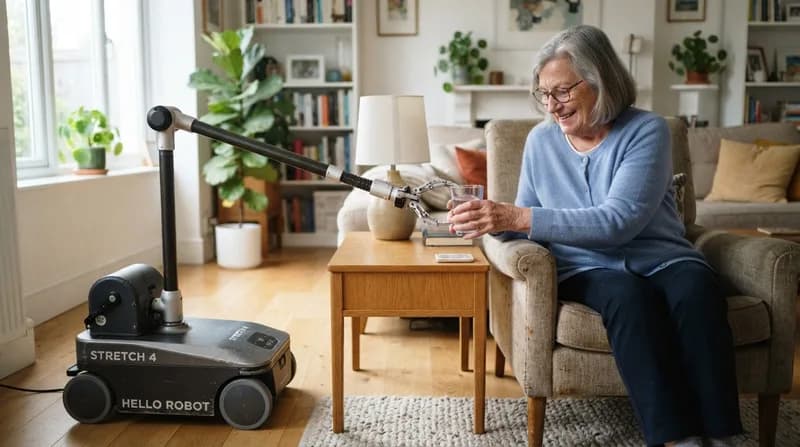
The Philosophy of Practical Robotics
In an industry often obsessed with viral videos of robots performing backflips or complex social mimicry, Hello Robot is carving out a decidedly different path. The company’s latest creation, the Stretch 4, prioritizes utility over theatrics. Designed to function in spaces built for humans, this compact, mobile assistant is engineered to tackle the granular, essential tasks that define daily independence. Whether it is grabbing a glass of water, brushing teeth, or adjusting household fixtures, Stretch 4 represents a pivot toward the real-world application of physical AI.
Led by CEO and co-founder Aaron Edsinger, whose pedigree includes pioneering work at Meka Robotics and a significant tenure at Google, the design of Stretch 4 is the result of over six years of rigorous customer feedback. Instead of focusing on the aesthetic of a humanoid form, the team opted for a pragmatic approach: a base on wheels paired with a highly dexterous, telescoping arm. This configuration allows the robot to navigate tight domestic environments while maintaining the contact sensitivity necessary to interact safely with fragile objects and human beings.
Engineering for Human Environments
The technical architecture of the Stretch 4 is specifically tuned for coexistence with people. By avoiding the inherent instability of bipedal designs, the wheeled base provides a stable platform for precision tasks. The single, high-reach telescoping arm offers a wide range of motion, enabling the robot to manipulate its environment in ways that significantly lower the barrier to entry for users with severe mobility impairments. The system is equipped with advanced sensors and perception capabilities, allowing it to interpret its surroundings and execute commands with delicate accuracy.
Beyond its mechanical capabilities, the Stretch 4 serves as a platform for the next generation of embodied AI research. Hello Robot has equipped the unit with a full-stack, open-source software platform, inviting developers and roboticists to build upon a hardware foundation that is already proven in real-world scenarios. By focusing on contact sensitivity and human-robot interaction (HRI), the platform addresses the critical challenges of safety and reliability, moving away from controlled lab experiments and into the messy, unpredictable reality of a home setting.
Why It Matters
- Beyond Humanoids: It proves that utility in a domestic setting does not require a human-like form, favoring stability and maneuverability instead.
- Accessibility Focus: The machine is specifically designed to grant agency to those with quadriplegia and other mobility challenges, turning theoretical AI research into life-changing assistive technology.
- Open Ecosystem: By providing an open-source software stack, Hello Robot is accelerating the development of applications for researchers, ensuring the hardware evolves alongside the software intelligence powering it.
- Proven Demand: The rapid sell-out of the first production run indicates a surging market interest in functional, personal robotics that offer immediate, tangible quality-of-life improvements.
Implications for the Robotics Industry
The emergence of Stretch 4 highlights a broadening gap in the robotics sector: the divide between flashy R&D projects and commercially viable assistive hardware. As AI continues to evolve, the demand for machines that can handle the physical world—performing "chores" rather than just processing data—is growing. Hello Robot’s decision to debut this technology on the main stage of industry forums signals that the industry is ready to take physical AI seriously as a tool for human empowerment, rather than just a source of digital content. As these units begin to populate more households, the lessons learned from their interaction with real-world users will likely define the next decade of robotics design, favoring robots that are quiet, reliable, and fundamentally helpful.