Breaking the Speed Limit of E-Ink
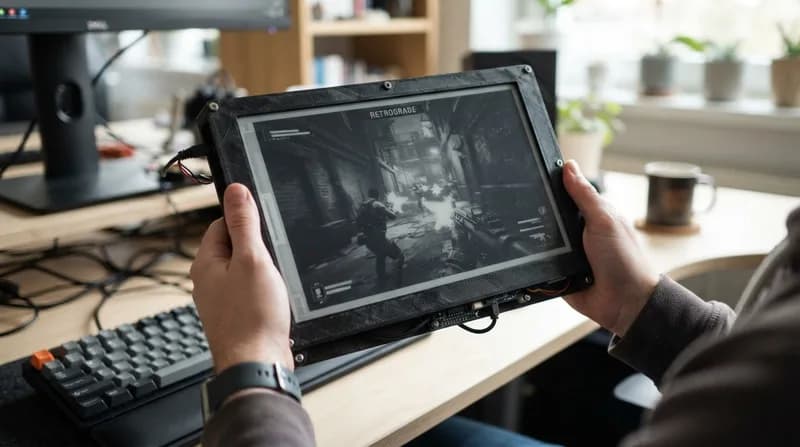
E-paper displays are marvels of power efficiency, ideal for static reading thanks to their ability to hold an image without a constant power draw. However, their physical architecture—which relies on moving pigment particles through an electrical field—has historically made them sluggish, typically relegated to refresh rates far too slow for motion-heavy applications. A recent breakthrough by the creator behind the YouTube channel 'Bo Made It' has shattered these expectations, bringing 30-frame-per-second grayscale gameplay to standard e-paper hardware.
The project, dubbed 'InkBoy,' leverages an ESP32-S3-powered board and a 1.54-inch stock display. By bypassing the standard, slow-moving manufacturer drivers, the creator engineered a custom waveform controller that pushes the hardware beyond its intended use case. This technical feat effectively enables fluid, retro-style gaming on a screen material that was never designed for it.
The Secret to Greyscale Motion
To achieve the look and feel of a classic 8-bit handheld console, the creator had to solve the problem of grayscale representation. Traditional E-Ink screens are binary, using black and white particles. While dithering is a common software approach to simulate grey, it often results in poor visual fidelity. The breakthrough occurred when the developer realized that by precisely timing the electrical pulses, the pigment transition could be interrupted mid-state.
By stopping the voltage at specific intervals during the pixel transition, the display generates legitimate shades of gray on demand. This discovery, paired with a custom driver that significantly shortens the waveform pulses, allows the screen to refresh at a staggering 30 frames per second—a nearly tenfold increase over the default 3.33 FPS offered by standard drivers. This method effectively turns a passive reading screen into a high-refresh, low-power gaming display.
Why it Matters
- Hardware Accessibility: Unlike previous attempts that required proprietary or highly customized hardware, this driver is designed for off-the-shelf, low-cost E-Ink panels.
- Open Source Potential: By releasing the driver on GitHub, the developer has provided a blueprint for others to experiment with high-refresh E-Ink projects, ranging from novel UI elements to unique portable emulators.
- Technical Innovation: It demonstrates that existing display hardware is often capable of performance far exceeding official software constraints, provided the user is willing to tinker with the underlying electrical waveforms.
A Word of Caution for Tinkerers
While the prospect of turning an old Kindle or a cheap development board into a high-speed gaming device is enticing, the creator offers a significant disclaimer. Pushing an E-Ink panel to refresh at 30 FPS requires aggressive voltage handling that the manufacturer never intended. This process carries a non-zero risk of permanently damaging the display or degrading the panel's lifespan significantly.
The project is currently available as an open-source repository for those with the appropriate hardware and a willingness to accept that their display might not survive the experimentation process. It stands as a brilliant example of 'vibe coding' and hardware hacking—where intuition and experimental software control collide to create something truly unexpected in the world of embedded systems.