A New Challenger in AI Compute
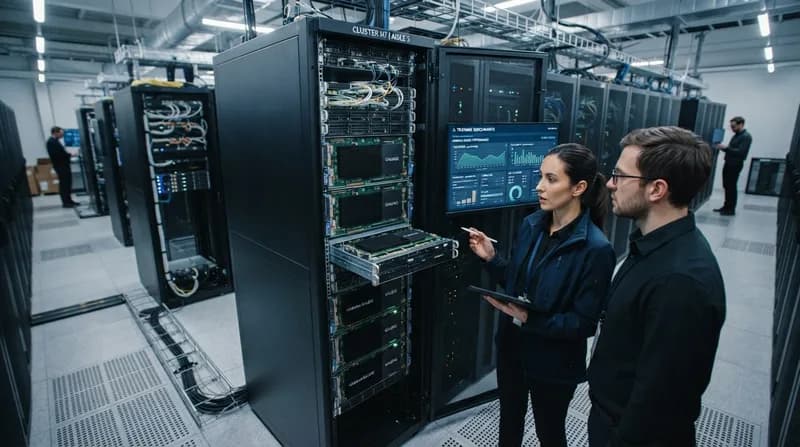
The landscape of high-performance AI hardware is shifting as developers seek alternatives to the dominant Nvidia ecosystem. Recent benchmarks focusing on the Habana Gaudi2 accelerator reveal that Intel’s specialized hardware is increasingly capable of going toe-to-toe with the industry-standard Nvidia A100 80GB. By focusing on deep learning workloads like Stable Diffusion, the Gaudi2 demonstrates that specialized architecture can achieve significant gains in both training speed and inference efficiency.
Key Advantages of Gaudi2
- Architecture Efficiency: Designed specifically for deep learning, the Gaudi2 leverages high-bandwidth memory (HBM) to maximize throughput during complex matrix multiplications.
- Training Throughput: Benchmarks indicate that Gaudi2 provides impressive scalability, allowing developers to reduce total training time for large generative models.
- Optimized Software Stack: Integration with the Habana SynapseAI software suite ensures that model developers can deploy pre-trained models with minimal configuration changes.
Why It Matters
For organizations reliant on large-scale generative AI, infrastructure costs are the single largest barrier to entry. The ability to utilize Gaudi2 not only introduces healthy competition into the hardware market but also provides an alternative path for companies looking to optimize their compute budget. As the industry moves toward larger, more compute-hungry foundation models, the efficiency of hardware accelerators like the Gaudi2 becomes critical to scaling.
Outlook and Implications
While Nvidia remains the gold standard for developer ecosystem support and CUDA dominance, the Gaudi2 proves that the hardware gap is narrowing. Moving forward, we expect to see more research labs and cloud providers diversifying their GPU clusters to include Habana accelerators. The shift towards multi-vendor AI infrastructure is not just a trend; it is a necessary evolution for the sustainability of the AI industry as demand for high-end compute continues to outpace supply chain capacities.