The Emergence of Gravity Linux
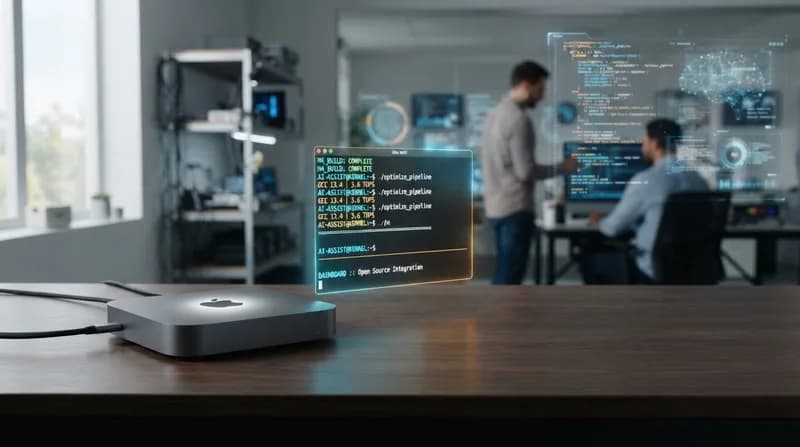
The landscape of open-source development for Apple Silicon has shifted with the emergence of Gravity Linux, a Fedora-based distribution. Unlike its predecessors, Gravity Linux has explicitly built its development philosophy around the use of Large Language Models (LLMs) and AI-driven coding agents. This controversial yet effective approach has allowed the project to achieve a significant milestone: booting an accelerated Linux desktop on the M4 Mac mini, a piece of hardware that only recently hit the market.
Gravity Linux functions as a fork of the long-standing Asahi Linux project, diverging primarily over the use of generative AI in software development. While the Asahi project maintains a strict policy against the use of LLMs for core contributions, the team behind Gravity—led by former Apple and OpenAI developer Cody Ho—believes these tools are essential for accelerating the complex task of reverse engineering Apple's proprietary hardware.
The Role of AI in Hardware Reverse Engineering
The speed at which the Gravity team enabled GPU acceleration on the M4 Mac mini is largely attributed to AI-assisted workflows. By utilizing coding agents for repetitive and highly technical tasks, Ho and co-developer Niklas Sheth were able to construct a custom hypervisor and an M4 GPU driver in a matter of weeks. The project relies on a "Clean-Room Policy" that permits the use of AI, provided that developers ensure no tainted information—specifically disassembled or decompiled proprietary Apple code—crosses into their implementation phase.
This methodology has sparked intense interest in the open-source community. The developers utilized LLMs to handle complex disassembly tasks, then strictly separated those findings from the actual coding work performed by humans. This ensures that the resulting drivers remain legally viable while benefiting from the raw efficiency of AI-powered analysis. Despite these advancements, the project remains in an early alpha stage, with developers cautioning that features like USB-C display support, Thunderbolt, and proper power management are still works in progress.
Comparison: Gravity Linux vs. Asahi Linux
While Gravity Linux has gained a speed advantage on the M4 architecture, it is important to contextualize the relationship between the two projects. Asahi Linux has spent years establishing a foundation for running Linux on Apple Silicon, providing the essential userspace APIs that allow projects like Gravity to exist. Asahi's more cautious, human-centric approach has historically ensured a high degree of stability and regulatory compliance, though it has faced setbacks following the departure of several lead contributors.
Gravity Linux serves as an experimental proof-of-concept for the future of rapid, AI-assisted hardware porting. It remains to be seen if the AI-generated drivers will reach the level of stability required for daily use or if they will eventually be upstreamed into the broader Linux ecosystem. For now, the M4 Mac mini implementation stands as a testament to the potential of balancing human oversight with machine-learning velocity in the complex realm of hardware enablement.
Why It Matters
- Hardware Velocity: The project demonstrates that LLMs can drastically reduce the time-to-market for community-driven drivers on cutting-edge proprietary hardware.
- Methodological Shift: This marks a pivotal moment in open-source culture, forcing a debate on whether rigid anti-AI policies effectively protect projects or simply slow down innovation.
- Legal Caution: The implementation of a "Clean-Room" policy combined with AI shows a maturing approach to handling proprietary binaries without infringing on intellectual property.