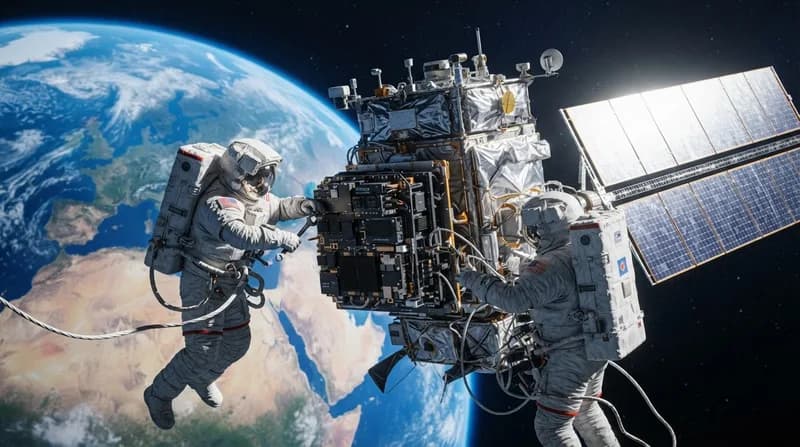
The Launch of Project Suncatcher
Google has officially initiated its foray into orbital computing, marking a significant milestone as the tech giant launched its first Tensor Processing Unit (TPU) payload into space. Part of the ambitious 'Project Suncatcher' initiative, the satellite is designed to test the feasibility of running high-performance AI workloads in the harsh environment of low Earth orbit. Built in partnership with Planet Labs, the satellite serves as a proof-of-concept for deploying Google's specialized silicon outside of terrestrial data centers.
The current mission is focused on fundamental stress testing, ensuring the hardware can handle the thermal constraints and power demands of orbital flight. By firing up the TPU in intermittent 15-minute intervals, Google aims to minimize the risk to the satellite’s primary systems while gathering critical telemetry on how advanced machine learning chips perform under cosmic conditions. This initial deployment is merely the precursor to a more robust demonstration scheduled for next year, which will feature two custom-built satellites capable of running complex, collaborative workloads linked by laser communications.
The Long-Term Vision: Orbital Data Clusters
Project Suncatcher is not merely a one-off experiment; it is the foundation for a futuristic vision of space-based infrastructure. Google anticipates a time when orbital data centers, composed of 81 satellites flying in tight formation, will perform massive parallel processing tasks in real-time. According to Travis Beals, the lead executive for Project Suncatcher, the goal is to account for the AI compute needs of the next five years, focusing on low-latency connections that allow for multi-rack workloads in the vacuum of space.
To support this, the company has released a detailed white paper in the journal Joule, which rigorously analyzes the economics and logistics required to establish such massive compute networks. The findings suggest that while radiation presents a challenge to logic circuitry, the error rates for standard inference workloads remain sufficiently low. The company has already adjusted its testing methodology to better reflect the shielding inherent in satellite configurations, ensuring that their chips are hardened against the unique stresses of the space environment.
The Math of the SpaceX Launch Cadence
A central pillar of Google's research involves the economics of orbital access. For space-based data centers to become a reality, launch costs must plummet. Google's analysis posits that SpaceX’s 'learning curve'—an estimated 20% annual reduction in costs—could bring launch prices down to approximately $200 per kilogram by 2035. However, achieving this scale is contingent on an extraordinary increase in flight volume.
The research concludes that for these cost targets to be met, SpaceX’s Starship vehicle would need to transport 370,000 tons of payload into orbit over the next decade. Based on current estimates, this implies roughly 1,800 launches over ten years, or 180 launches annually, assuming each mission carries 200 metric tons. While this represents a monumental increase from current flight rates, it highlights the immense logistical scaling necessary to turn orbital computing from a scientific novelty into a commercial reality.
Why It Matters
- Strategic Computing: Moving AI inference to space could redefine how global data is processed, reducing latency for localized applications.
- Hardware Resilience: Proving that standard consumer-grade AI accelerators like TPUs can survive in orbit opens the door for a wave of space-hardened edge computing.
- Infrastructure Dependencies: The viability of this project is explicitly tethered to the successful scaling of heavy-lift launch vehicles, specifically SpaceX's Starship.