The Path to Sovereign Compute
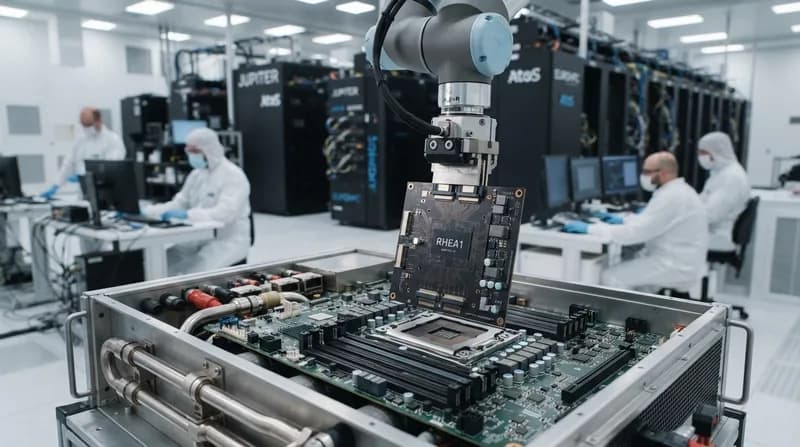
In a significant milestone for European digital sovereignty, the JUPITER supercomputer—the EU’s first exascale-class machine—has officially begun the integration of domestic silicon. SiPearl, the French semiconductor designer at the forefront of this initiative, has commenced the delivery of its Rhea1 CPUs to system builder Bull. While JUPITER made headlines last year as the fifth most powerful supercomputer on the Top500 list, its initial performance was driven largely by 24,000 American-made Nvidia GH200 superchips. The arrival of the Rhea1 marks the start of a transformation that shifts the system from a reliance on foreign acceleration to a hybrid model featuring custom, locally developed processors.
The Architecture of Rhea1
Designed specifically to handle high-performance computing (HPC) and complex scientific simulations that often struggle on GPU-heavy architectures, the Rhea1 is an 80-core processor built on Arm’s Neoverse V1 core architecture. Despite the rapid pace of silicon development elsewhere, the Rhea1 is a feat of engineering, packing an impressive 61 billion transistors. Its design philosophy leans heavily into memory throughput, prioritizing data access speeds over raw graphical compute power, a strategy reminiscent of the architecture that powered Japan’s legendary Fugaku supercomputer to the top of the global rankings.
To support high-bandwidth memory requirements, each Rhea1 unit is equipped with four stacks of HBM2e memory, providing 64 GB of capacity and reaching a staggering 1.8 TB/s of bandwidth. The chip also features four DDR5 memory channels, ensuring that memory-bound applications—such as large-scale climate modeling or fluid dynamics simulations—can run with unprecedented efficiency. When fully integrated, the JUPITER CPU partition will encompass 1,300 nodes and 2,600 processors, contributing approximately 5 petaFLOPS of compute power to the overall system.
Why It Matters
- Technological Independence: The project reduces Europe's total dependence on non-EU chip suppliers for mission-critical scientific infrastructure.
- Workload Versatility: While GPUs dominate AI training, many scientific simulations require high-speed CPU-based processing; the Rhea1 addresses this specific gap.
- Ecosystem Building: The delivery proves that the European HPC JU initiative can successfully bridge the gap between research, industry, and manufacturing.
Future Outlook
The successful deployment of Rhea1 is just the first step in a broader strategy. SiPearl has already set its sights on the next iteration, with the Rhea2 chip slated for integration into the upcoming Alice Recoque supercomputer. By pairing future European CPUs with high-end accelerators like AMD’s MI430X, the EU is building a roadmap for a resilient, domestic supercomputing supply chain. As JUPITER continues its evolution, it stands as a testament to the continent's commitment to sustaining a competitive, sovereign infrastructure capable of tackling the most demanding research challenges of the next decade.