A New Paradigm in Robotics
For years, the robotics industry has chased the dream of human-like dexterity by feeding robots massive amounts of video data, attempting to teach machines to mimic the visual patterns of human movement. Eka Robotics, a startup founded by MIT professor Pulkit Agrawal and former Google DeepMind researcher Tuomas Haarnoja, is betting that this approach has been fundamentally flawed. Their solution? A radical pivot toward a vision-force-action model that prioritizes the physical reality of touch, contact, and force feedback.
This innovative approach has caught the attention of major venture firms, with Eka recently closing a $150 million Series A round, bringing the startup’s post-money valuation to a staggering $1.45 billion. Led by a16z and F-Prime, the investment underscores a growing industry sentiment that the key to unlocking true robotic agility isn't found in a screen, but in the physical tension of a gripper meeting an object.
The Tech Behind the 'Wow Factor'
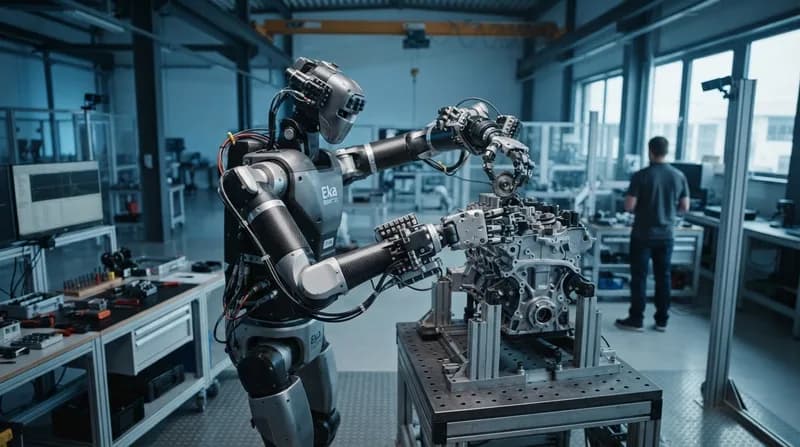
At the heart of Eka’s performance is a custom-designed, highly flexible robotic hand equipped with advanced force sensors. While most robotics companies focus on visual processing—identifying what an object is and where it sits—Eka focuses on what the robot actually feels during the act of manipulation. Their foundational model integrates language and visual inputs with real-time force data, allowing the robot to execute tasks like handling fragile items—such as a ripe raspberry—without crushing them.
The speed and reliability of these machines are proving to be transformative. In recent demonstrations, Eka’s systems managed to pick up approximately 1,500 objects per hour with a success rate exceeding 95%. This efficiency significantly outperforms human capacity, while the robot's ability to recover from failures by trying different grip approaches offers a level of "humanness" that observers describe as both impressive and occasionally unsettling.
Why it Matters
- Closing the 'Last Millimeter' Gap: Eka’s founders argue that vision is only useful for positioning, while the actual task of gripping is governed by the physics of contact.
- Sim-to-Real Scalability: By utilizing high-fidelity physics simulators, Eka generates thousands of hours of training experience in minutes, bypassing the need for slow, manual human demonstrations.
- Hardware Economics: The company is aiming for high reliability with low-cost components, currently targeting a hardware cost of under $1,000 for its specialized grippers.
The Road Ahead: From Lab to Line
Despite the hype, Eka faces the classic roboticist challenge: moving from controlled lab environments to the messy, unpredictable reality of industrial assembly lines. While the company is already running secretive pilot programs focusing on pick-and-place operations and wire manipulation, the true test lies in longevity. The goal is to develop systems that can operate for millions of duty cycles without mechanical or algorithmic failure.
Currently, the company's hardware is rated for 5 million cycles, with the engineering team pushing toward the industry-standard benchmark of 20 million. By tackling specific, high-value industrial verticals first, Eka aims to prove the robustness of its physics-based AI before attempting more complex general-purpose tasks. As the field of robotics continues to evolve, Eka’s bottom-up focus on physical intelligence may well serve as the blueprint for the next generation of industrial automation.