The Rise of AI-Assisted Code Migration
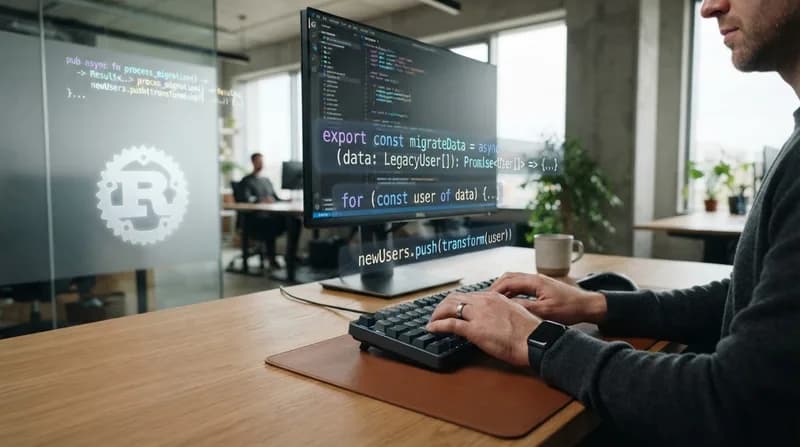
In a demonstration of how far automated software engineering has come, YouTuber and developer Theo Browne has successfully leveraged AI agents to port the complex TypeScript compiler to Rust. The project, which cost approximately $24,000 in API tokens, serves as a proof-of-concept that modern foundation models are no longer limited to simple scripts or boilerplate code. Instead, they are becoming capable of handling massive, architectural-level software migrations that previously required months of human developer effort.
The project, dubbed TS_Rust, managed to pass TypeScript conformance tests with nearly perfect accuracy. This achievement is particularly striking given the sheer scale of the TypeScript codebase. Unlike previous attempts that relied on manual code analysis, this endeavor utilized the strategic reasoning capabilities of high-end models, which autonomously decided to translate from Microsoft’s Go-based implementation rather than the original JavaScript, bypassing insurmountable technical hurdles in the process.
Performance and Memory Gains
The implications for software performance are significant. Browne reports that the Rust-based port runs twice as fast as Microsoft's official Go-based TypeScript rewrite (v7) and is over 12 times faster than the preceding v6 version. By choosing Rust, the AI effectively eliminated the overhead typically associated with garbage-collected languages, creating a leaner execution environment.
This efficiency is the catalyst for a broader vision: reducing the resource footprint of AI agents themselves. Currently, running agentic workflows often requires full virtual machines or Docker containers to manage environments. By utilizing the Rust-based compiler, developers could potentially run TypeScript-based agents directly within the Google V8 engine. Because Rust lacks a heavy runtime and compiles efficiently to WebAssembly, it avoids the compatibility conflicts that occur when bundling Go’s garbage collector, ultimately allowing for much lighter, more scalable agent deployments.
Why it Matters
- Cost-Efficient Engineering: While $24,000 is a significant sum, it represents a fraction of the payroll cost for a team of software engineers performing a manual migration of this magnitude.
- Strategic Model Autonomy: The AI demonstrated high-level reasoning by choosing the Go version of TypeScript as a bridge, successfully porting the logic and its idiosyncrasies without explicit instruction from the user.
- Future-Proofing Infrastructure: As inference costs continue to plummet, the bottleneck for AI development is shifting toward the underlying compute cost of the environments in which models operate. Lightweight, Rust-based tooling could be the key to making agentic workflows commercially viable at scale.
The Future of Automated Refactoring
TS_Rust sits alongside an increasing number of high-profile projects where AI is being used to modernize legacy infrastructure. Companies like Microsoft and Google are already employing similar strategies to move massive C/C++ codebases to memory-safe languages like Rust, saving significant labor and improving system security. The success of Browne’s project signals a shift where "impossible" software tasks are becoming standard practice for those willing to harness the power of agentic workflows.
As these models continue to evolve, the distinction between human-driven and AI-driven development is blurring. The ability to port complex, multi-layered compilers without the direct intervention of a human developer suggests that we are entering an era where software architecture can be fluid, refactored, and optimized on demand, provided the right model is tasked with the job.