ScienceTechnical Deep Dive

Deciphering the Grave: DNA Reveals Medieval Burial Myths

Published
EElectricBuzz Editorial Team
Deciphering the Grave: DNA Reveals Medieval Burial Myths
3 min read508 wordsElectricBuzz Editorial Team

The Gist

“A groundbreaking genomic study from Stockholm University challenges long-held assumptions about medieval family burials, revealing complex social structures and early gender norms.”

Beyond Biological Kinship

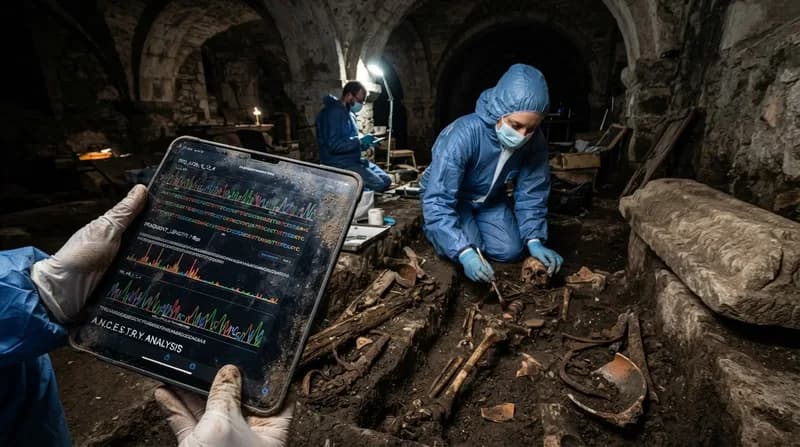
For generations, archaeologists have operated under a standard assumption: if an adult and a child were found resting together in a medieval grave, they were likely parent and child. However, a major new study from Stockholm University, published in Science Advances, is upending this narrative. By analyzing the DNA of 142 individuals from Viking and medieval sites in Sweden, including Sigtuna and Västerhus, researchers have uncovered that proximity in death did not necessarily imply a biological relationship. The genetic data reveals that close kinship was surprisingly rare among those interred in shared graves, suggesting that medieval societies prioritized social, religious, or community-based criteria when deciding who belonged together in the afterlife.

This shift in understanding indicates that burial practices were far more nuanced than simple familial tradition. Researchers argue that ancient DNA serves as a critical tool that allows modern science to move past speculative archaeological interpretations, finally providing a way to test historical hypotheses against empirical genetic evidence. The study confirms that community belonging often superseded bloodlines in the context of Scandinavian funerary rites.

Gender Identity and Early Childhood

The research also shed light on how medieval society categorized individuals, particularly children. Before the advent of paleogenetics, identifying the biological sex of younger remains was notoriously difficult and often unreliable. By utilizing DNA analysis, the team successfully determined the sex of children and adolescents, revealing a fascinating pattern in how they were buried. It appears that children were not treated as a distinct, separate demographic in death.

At the Västerhus church ruins, researchers observed that men and women were traditionally buried on opposite sides of the churchyard. Crucially, the children analyzed in the study were placed in accordance with these same gendered spatial patterns. This consistency suggests that medieval Scandinavian society recognized gender identity from a very young age and integrated children into the adult social and religious structures immediately. Rather than being categorized as 'children' first, these individuals were treated as members of their respective gender groups from their earliest years.

The Remarkable Journey of 'Lady 56'

Perhaps the most compelling narrative to emerge from the genetic data is that of an individual researchers have dubbed 'Lady 56.' Through genomic sequencing, scientists were able to reconstruct her family tree, linking her to her parents, a brother, and two daughters. While the DNA established her biological connections within the local cemetery, the artifacts buried alongside her hint at a life that transcended the borders of her immediate community.

Lady 56 was discovered with a scallop shell, a poignant and historically significant object that served as a symbol of the pilgrimage to Santiago de Compostela in Spain. Given that this site is located at the far western edge of Christian Europe, the presence of the shell suggests that this young woman, who died before reaching the age of 30, may have traversed thousands of kilometers across the continent. Her story highlights how medieval individuals were far more mobile and connected than previously assumed, even as their social networks remained rooted in complex, community-defined burial customs.


SPONSORED
The 5 Best Over-Ear ANC Headphones of 2026, Tested & Ranked
Editor's Pick Guide
92/100
Tech & Gadgets•12 min read

The 5 Best Over-Ear ANC Headphones of 2026, Tested & Ranked

We locked five over-ear ANC picks for 2026 — Sony WH-1000XM6, Bose QuietComfort Ultra 2, Soundcore Space One, Sennheiser Momentum 5, and Apple AirPods Max 2 — then stress-tested them on lab metrics, long-term owner truth, and live street prices.

Related Stories

Semantically matched articles, ranked by topic overlap and freshness.

Novel Nasal Spray Offers Needle-Free Pain Relief for Pediatric Emergencies
Science

Novel Nasal Spray Offers Needle-Free Pain Relief for Pediatric Emergencies

A breakthrough clinical study reveals that a combination of sufentanil and ketamine delivered via nasal spray can rapidly manage moderate to severe pain in children without the distress of injections.

Breakthrough Trial Reveals 69% Drop in Stroke Risk for Intermediate-Risk AFib Patients
Science

Breakthrough Trial Reveals 69% Drop in Stroke Risk for Intermediate-Risk AFib Patients

A landmark clinical trial has demonstrated that direct oral anticoagulants significantly protect patients with intermediate stroke risk from serious cardiovascular events without increasing bleeding complications.

Ancient Fossil Cache Rewrites the Timeline of Oxygen-Dependent Complex Life
Science

Ancient Fossil Cache Rewrites the Timeline of Oxygen-Dependent Complex Life

A massive discovery of 1.7-billion-year-old microfossils in Australia provides definitive evidence that the dawn of complex life was tied to oxygen availability.

A Decade of Progress: Uterus Transplants Emerge as a Proven Clinical Path to Parenthood
Science

A Decade of Progress: Uterus Transplants Emerge as a Proven Clinical Path to Parenthood

A comprehensive national review reveals that uterus transplantation has matured from an experimental procedure into a reliable clinical reality, boasting a 70% success rate for live births.

Common Joint Supplement Linked to Accelerated Alzheimer’s Progression
Science

Common Joint Supplement Linked to Accelerated Alzheimer’s Progression

New research from the University of Florida suggests that glucosamine, a popular over-the-counter joint supplement, may accelerate cognitive decline in patients with existing memory impairment.

Unlocking New Paths: Researchers Identify Protein-Degradation Trigger for Inherited Heart Arrhythmias
Science

Unlocking New Paths: Researchers Identify Protein-Degradation Trigger for Inherited Heart Arrhythmias

A groundbreaking study has identified how a specific protein-degradation mechanism drives a life-threatening heart condition, paving the way for potential new therapies.

Beyond Cannabinoids: Hidden Medicinal Potential Found in Cannabis Waste
Science

Beyond Cannabinoids: Hidden Medicinal Potential Found in Cannabis Waste

Researchers have identified rare, previously overlooked compounds in discarded cannabis leaves that could revolutionize future biomedical research.

Unlocking Memory: How Personalized Music Bypasses Dementia's Neural Barriers
Science

Unlocking Memory: How Personalized Music Bypasses Dementia's Neural Barriers

New neurological research reveals that personally meaningful music triggers distinct brain activity in dementia patients, offering a potential breakthrough for non-pharmacological therapy.