The Case Against TCP
For decades, Transmission Control Protocol (TCP) has served as the backbone of the internet and cloud computing. Developed to ensure reliable data delivery across unpredictable connections, its design is rooted in the concept of a continuous byte stream. However, Stanford University professor emeritus John Ousterhout argues that this architectural heritage has become a liability. In the high-stakes environment of modern AI datacenters, where GPUs are frequently left idle while waiting for data, TCP’s reliance on flow control mechanisms that struggle to prioritize short, urgent packets creates significant performance degradation.
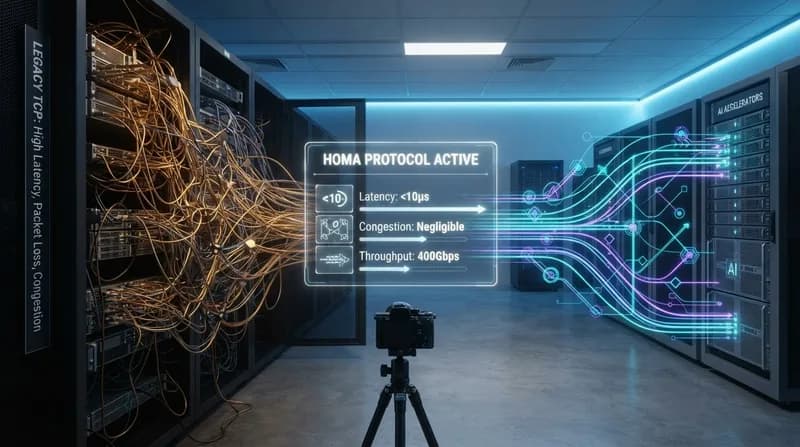
Ousterhout is now championing Homa, a transport protocol originally proposed in a 2019 dissertation by Behnam Montazeri. Unlike the stream-oriented TCP, Homa is message-based. This fundamental shift allows the protocol to treat data as distinct units with defined lengths, rather than an undifferentiated flow of bytes. By enabling the receiver to explicitly manage congestion and prioritize shorter, latency-sensitive messages through a Shortest-Remaining-Processing-Time (SRPT) algorithm, Homa addresses the specific friction points that plague large-scale AI model training and coordination tasks.
Why It Matters
- Latency Reduction: Homa significantly outperforms TCP, achieving p99 latency of just 92 microseconds for short messages, compared to 1.2 milliseconds for TCP under similar 100 Gbps conditions.
- Deployment Flexibility: Designed as a drop-in replacement, Homa can be compiled from source and integrated into Linux kernels as a module. It operates alongside TCP, allowing organizations to migrate applications incrementally without needing to reboot servers.
- GPU Efficiency: In modern AI labs, network latency directly impacts the ROI of expensive hardware. By accelerating metadata coordination and cache lookups, Homa keeps GPUs running rather than waiting for data transfers to clear.
- Protocol Evolution: While TCP remains the dominant standard, the industry is increasingly using workarounds like QUIC, RDMA, and NVMe-oF to bypass its limitations. Homa represents a more direct, clean-slate attempt to modernize the data transport layer specifically for the datacenter.
Implementation and Outlook
The path toward broad adoption for any new networking protocol is notoriously difficult, yet Homa is already making tangible progress. Ousterhout is actively working to upstream the protocol into the Linux kernel and has recently seen it backported to Red Hat Enterprise Linux 8 and 9.5. Furthermore, he is currently collaborating with a major financial services firm on a live prototype, testing the protocol's viability outside of controlled academic environments.
Despite this momentum, the protocol faces significant skepticism. Critics have questioned the performance characterizations offered by Ousterhout, suggesting that the industry's existing tools for congestion management and specialized fabrics may already be sufficient for most high-performance needs. Whether Homa is a revolutionary breakthrough for AI workloads or an over-engineered solution to a problem already being addressed by other technologies remains to be seen. However, as AI models grow in complexity and demand more from datacenter interconnects, the conversation around replacing or supplementing TCP is unlikely to subside anytime soon.