California’s Clean Transit Push
California has announced a major financial commitment to reshape the state’s public transportation landscape. With a fresh infusion of nearly $1.3 billion, Governor Gavin Newsom’s administration aims to modernize rail infrastructure and aggressively transition transit fleets to zero-emission technology. The funding, sourced from Senate Bill 1 and the state’s Cap-and-Invest program, arrives as the state seeks to solidify its position as a global leader in climate action ahead of the COP31 climate summit.
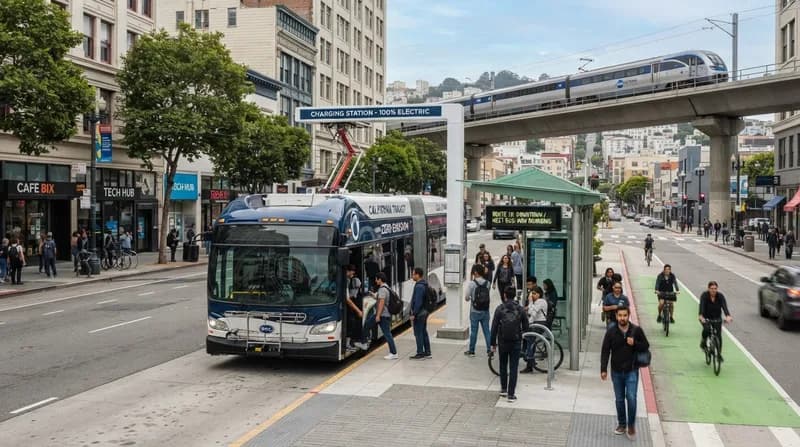
While a significant portion of this capital is earmarked for long-term rail connectivity and maintaining critical train service levels, the investment marks a turning point for road-based public transport. By prioritizing the deployment of battery-electric and hydrogen fuel cell buses, the state is actively removing combustion engines from municipal streets, directly improving air quality in heavily populated urban corridors.
Expanding the Zero-Emission Fleet
A central pillar of this initiative is the procurement of over 75 new zero-emission vehicles. Santa Monica’s Big Blue Bus system is a primary beneficiary, utilizing these funds to complete its transition toward an entirely electric fleet. This shift serves as a blueprint for other urban areas, demonstrating the feasibility of full-scale electrification in public transit operations.
The rollout is geographically diverse, ensuring that environmental benefits reach various regions across the state. In Northern California, the Sacramento region is slated to receive 21 hydrogen fuel cell buses to bolster connection capacity between Sacramento and Davis. Meanwhile, in the Central Valley, Kings County will pair new battery-electric buses with modern transit facilities to create seamless access to future high-speed rail hubs. Further zero-emission buses and microtransit shuttles are scheduled to debut in Marin, Los Angeles, Ventura, and Riverside counties, as well as the city of Montebello.
Rail Innovation and Infrastructure
Beyond buses, the initiative focuses on rail as the backbone of efficient, clean travel. A standout project is the allocation of $750 million to "The Portal," a critical infrastructure development that extends Caltrain approximately two miles into downtown San Francisco. This expansion will bridge the gap between current transit services and the Salesforce Transit Center, positioning the hub to accommodate future high-speed rail lines.
Innovation is not limited to heavy rail, however. The state is sponsoring a pilot program for a battery-electric train running between San Jose and Gilroy, testing the viability of clean propulsion for commuter rail lines. Additionally, Northern California is seeing a push for "last-mile" mobility through the expansion of e-bike sharing programs in Truckee. To ensure existing services remain reliable, a $20 million grant was also awarded to Metrolink, preventing drastic service cuts and ensuring that Southern California’s rail network remains robust through the 2028 Olympic and Paralympic Games.
Why It Matters
- Decarbonization: Accelerates the phase-out of diesel-powered public transit vehicles.
- Reliability: Prevents service reductions for essential commuters in Southern California.
- Future-Proofing: Integrates local transit networks with upcoming high-speed rail corridors.
- Economic Impact: Creates a localized "green" transit economy by funding domestic technology procurement and modern facility construction.