Scaling Sustainable Logistics
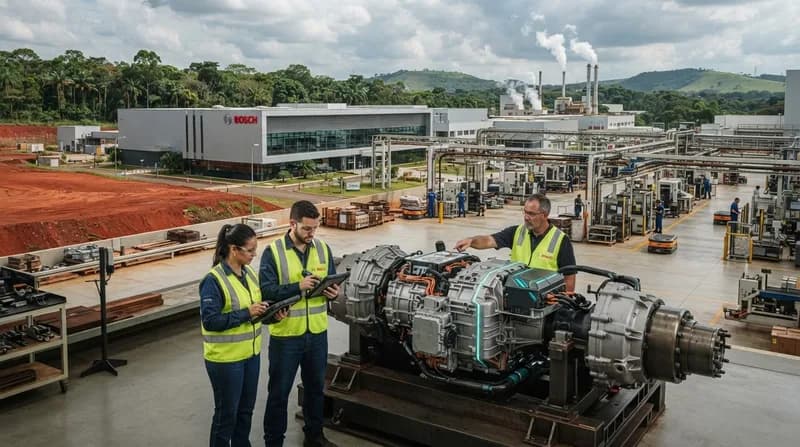
Bosch has announced a significant industrial expansion at its Campinas facility in São Paulo, Brazil. Starting in 2027, the plant—which currently focuses on smaller vehicle components like seat adjustment motors—will pivot to include the production of full-scale electric motors for commercial trucks and trailers. This move is part of a broader R&D and manufacturing investment totaling one billion Brazilian real (approximately €155 million), signaling the company's commitment to the regional electrification of heavy transport.
By localizing the supply chain, Bosch aims to reduce the reliance on imported powertrain hardware, allowing commercial fleet operators in Brazil to transition to electric vehicles more efficiently. The Campinas plant will serve as a hub for critical electrification hardware, including specialized control units, inverters, and high-efficiency transmissions specifically engineered for the rigors of heavy-duty commercial use.
Strategic Partnership for E-Axle Innovation
In addition to its independent manufacturing plans, Bosch has formed a high-stakes partnership with Suspensys, a subsidiary of the Randoncorp Group. This collaboration is designed to accelerate the development of integrated e-axle systems, a crucial technology for modern electric trucks that combines the motor, transmission, and power electronics into a single, space-efficient unit located directly at the wheel drive.
The partnership focuses on refining and integrating Suspensys’ existing 'e-Sys' and 'Rigid eAxle' (REA) platforms. By combining Bosch’s deep technical expertise in power electronics and motor design with Suspensys’ established hardware footprint in the Latin American truck market, the companies intend to create robust, locally-optimized solutions. This integrated approach not only simplifies the assembly process for truck OEMs but also addresses the unique infrastructural challenges found in the Brazilian logistics landscape.
Why It Matters
- Supply Chain Localization: Reducing dependence on international imports makes the transition to electric mobility more cost-effective and resilient for the Brazilian commercial sector.
- Technological Versatility: The shift covers a wide array of electrified components, from control units to full transmission systems, ensuring a comprehensive ecosystem for truck electrification.
- Regional Growth: The €155 million investment package supports not just manufacturing, but also local digitalization and research initiatives, positioning Brazil as a key player in the global move toward zero-emission freight.
As the commercial trucking industry seeks to lower its carbon footprint, these localized production capabilities provide the necessary foundation for fleet operators to scale their operations without sacrificing the performance or durability required for long-haul and regional logistics.