The Rise of the Enterprise Token Factory
As the demand for agentic AI explodes, businesses are shifting from experimental pilots to full-scale production. Unlike frontier model developers who can build custom, greenfield campuses, most enterprises must integrate high-density AI hardware into existing datacenter footprints. The challenge, according to industry analysts, is moving beyond theoretical peak performance to achieving sustained, reliable inference—what is increasingly being described as operating a 'token factory' that runs 24/7.
ASUS has responded to this shift by unveiling its latest hardware lineup built on the NVIDIA HGX Rubin platform. These systems are designed to balance the extreme power requirements of modern GPU computing with the practical realities of enterprise maintenance, cooling, and facility limitations.
1. The XR R1I12B-M1BLFS (2U Fully Liquid-Cooled)
Designed for maximum thermal efficiency, the 2U model is a fully liquid-cooled powerhouse. By implementing direct-to-chip cooling on every GPU, ASUS aims to prevent thermal throttling, ensuring that the system delivers consistent, sustained performance throughout long inference cycles. This is critical for agentic AI, which operates in continuous loops rather than discrete, sporadic batches.
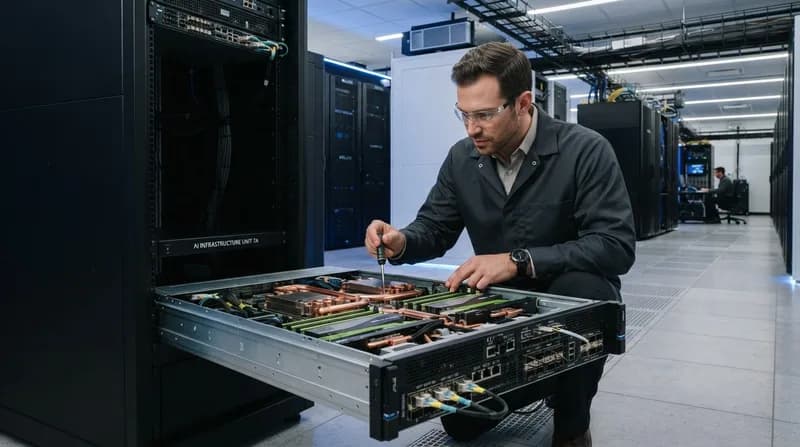
Maintenance is a primary focus for this model. ASUS has engineered the unit with independent, tool-less sleds for both CPUs and GPUs. By isolating these components and their respective cooling loops, technicians can perform routine service without the massive downtime typically associated with draining complex liquid-cooling systems, a vital feature for businesses that cannot afford production gaps.
2. The XR R1I12B-M1BHFS (3U Hybrid-Cooled)
The 3U hybrid-cooled model offers an alternative approach for datacenters that may require more flexibility in their cooling infrastructure. This system utilizes liquid cooling for the primary GPU components to maintain high-performance output while employing air cooling for the CPUs. ASUS claims that this hybrid design can reduce total maintenance time by up to 50 percent compared to traditional fully liquid-cooled configurations.
This model is built to provide granular compute scaling, allowing enterprises to purchase AI capacity in digestible 'blocks' rather than massive clusters. It offers expanded storage options, with support for both U.2 and E1.S drive formats, providing users with the ability to optimize local data access based on their specific workload requirements.
Why it Matters: The Shift to Sustained Reliability
- Sustained vs. Peak: While peak FLOPS make headlines, enterprises prioritize sustained throughput to ensure their AI agents remain operational around the clock.
- Facility Integration: With most datacenters capped at 30kW per rack, the ASUS systems provide power-efficient, cable-free designs that simplify deployment in existing halls.
- Infrastructure Lifecycle: ASUS is offering a full service suite, from initial facility assessment to the 'Infrastructure Deployment Center' (AIDC) software, effectively acting as a partner rather than a vendor.
By focusing on rack-level integration, connectivity through 800Gb/s east-west bandwidth, and simplified serviceability, ASUS is positioning these systems as the engine room for the next wave of enterprise AI adoption. Both models are available this quarter, providing a structured path for businesses to scale their AI capabilities without reinventing their entire IT foundation.