Artificial IntelligenceTechnical Deep Dive

AstroForge Turns to Transformer-Based AI for Deep Space Autonomy

Published
EElectricBuzz Editorial Team
AstroForge Turns to Transformer-Based AI for Deep Space Autonomy
3 min read483 wordsElectricBuzz Editorial Team

The Gist

Moving beyond traditional flight control, asteroid mining startup AstroForge is developing an autonomous 'Solo' AI stack to manage spacecraft without constant ground-based intervention.

The Shift Toward Autonomous Space Flight

Space exploration has historically been a labor-intensive endeavor. Missions like NASA’s OSIRIS-REx required massive teams of ground-based flight controllers to monitor every critical movement, a reality that presents a major barrier for resource-constrained startups aiming to mine asteroids. AstroForge, a company focused on the next frontier of space commerce, is looking to bypass this logistical bottleneck by handing the helm over to a specialized AI.

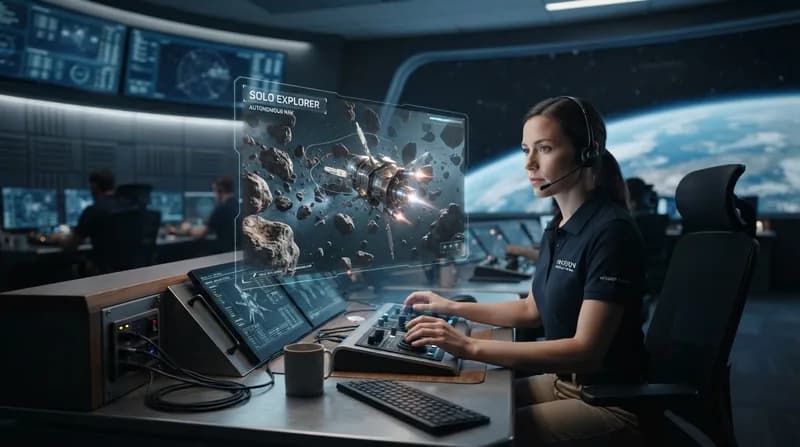
The company has developed an in-house, transformer-based control stack dubbed "Solo." Unlike traditional mission control methods, which rely on rigid algorithms and constant communication windows with Earth, Solo aims to provide spacecraft with the cognitive capability to resolve anomalies and maintain navigation in real-time. By leveraging advancements in transformer models similar to those used in the latest large language models, AstroForge is designing a system capable of interpreting complex sensor data to make critical "on-the-fly" decisions.

Why It Matters

The reliance on AI for space navigation represents a significant departure from current aerospace standards. While neural networks are ubiquitous on Earth, their use in deep space has been limited by concerns over reliability and predictability. AstroForge is testing these limits, shifting the paradigm from "human-in-the-loop" control to autonomous self-governance. If successful, this could slash mission operational costs, currently estimated at hundreds of millions of dollars for ground network infrastructure, and enable long-duration missions in regions of space where light-speed latency makes direct communication nearly impossible.

The Road to Autonomy

The development of Solo was heavily influenced by hard-learned lessons from previous missions. Past attempts by AstroForge to maintain deep space contact were hampered by the extreme scarcity of global deep-space antennas and the narrow time windows allowed for manual intervention. The company's "Odin" spacecraft, which faced communication difficulties in 2025, served as a catalyst for this pivot. The leadership team realized that the best path forward wasn't to build a more expensive radio network, but to build a more intelligent vehicle.

  • System Integration: The Solo stack integrates traditional control algorithms with a diagnostic intelligence layer trained on over 2,500 onboard sensors.
  • Shadow Mode Testing: The upcoming DeepSpace-2 vehicle will host Solo in "shadow mode," allowing engineers to validate its decision-making against real-world inputs without surrendering full control.
  • Deployment Timeline: AstroForge plans to launch its first fully autonomous mission in 2027 via Stoke Space, with NASA backing the initiative to gather heliophysics data.

Ultimately, AstroForge’s vision is to create an agent that can handle complex system failure, such as correlating a power fluctuation to a malfunctioning star tracker and executing a hard reboot without waiting for instructions from a technician on Earth. While CEO Matthew Gialich playfully notes that his team is still trying to convince him to keep emergency radios on the 2027 mission, the goal is clear: to prove that when it comes to deep space, a machine that can think for itself is more valuable than one that just listens.


The 5 Best Over-Ear ANC Headphones of 2026, Tested & Ranked
Editor's Pick Guide
92/100
Tech & Gadgets12 min read

The 5 Best Over-Ear ANC Headphones of 2026, Tested & Ranked

We locked five over-ear ANC picks for 2026 — Sony WH-1000XM6, Bose QuietComfort Ultra 2, Soundcore Space One, Sennheiser Momentum 5, and Apple AirPods Max 2 — then stress-tested them on lab metrics, long-term owner truth, and live street prices.

Related Stories

Semantically matched articles, ranked by topic overlap and freshness.

Anthropic Unveils Opus 5.5: Greater Intelligence at Lower Costs
Artificial Intelligence

Anthropic Unveils Opus 5.5: Greater Intelligence at Lower Costs

Anthropic has launched its most capable model yet, Opus 5.5, which outperforms competitors while simultaneously lowering the cost of entry for developers.

Hugging Face Introduces Chat Templates to Eliminate Silent AI Performance Issues
Artificial Intelligence

Hugging Face Introduces Chat Templates to Eliminate Silent AI Performance Issues

New Jinja-based chat templates are set to solve the hidden problem of mismatched formatting that plagues large language model performance.

Hugging Face Integrates GGUF Support into Transformers
Artificial Intelligence

Hugging Face Integrates GGUF Support into Transformers

The Hugging Face Transformers library now natively supports llama.cpp quantization formats, significantly simplifying local AI model deployment.

Hugging Face Brings High-Speed SDXL Inference to Google Cloud TPU v5e
Artificial Intelligence

Hugging Face Brings High-Speed SDXL Inference to Google Cloud TPU v5e

New optimizations using JAX and Google Cloud's latest TPU v5e hardware allow for dramatically faster and more cost-effective Stable Diffusion XL image generation.

Closing the Reproducibility Gap: UK AISI Partners with EvalEval to Standardize AI Benchmarking
Artificial Intelligence

Closing the Reproducibility Gap: UK AISI Partners with EvalEval to Standardize AI Benchmarking

The UK AI Security Institute is adopting the 'Every Eval Ever' schema to bring transparency, consistency, and scientific rigor to frontier model evaluations.

The Heavyweight Investors Judging TechCrunch Disrupt 2026's Startup Battlefield
Artificial Intelligence

The Heavyweight Investors Judging TechCrunch Disrupt 2026's Startup Battlefield

TechCrunch reveals the latest cohort of top-tier venture capitalists set to judge the Startup Battlefield 200 at Disrupt 2026, offering a glimpse into the expertise guiding the next generation of founders.

Boosting SDXL Efficiency: The TAESDXL Breakthrough
Artificial Intelligence

Boosting SDXL Efficiency: The TAESDXL Breakthrough

A look at the latest optimizations for SDXL that significantly streamline latent decoding for faster, lighter generation.

Hugging Face Welcomes PatchTSMixer for Efficient Time-Series Analysis
Artificial Intelligence

Hugging Face Welcomes PatchTSMixer for Efficient Time-Series Analysis

Hugging Face has officially integrated the PatchTSMixer model, offering a lightweight, high-performance solution for complex multivariate time-series forecasting.