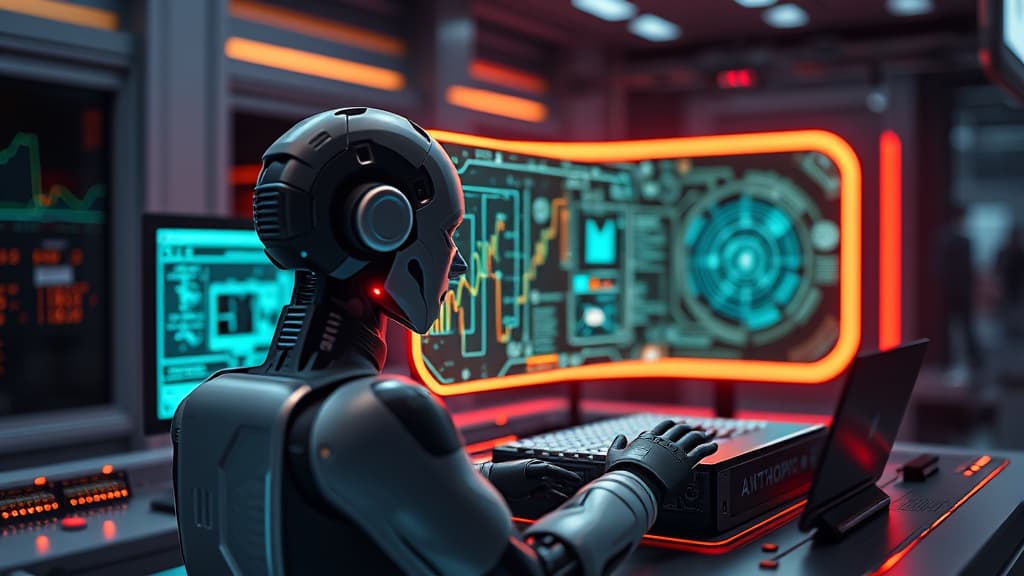
Anthropic, a leading AI research company, has unveiled a significant step forward in bridging the gap between artificial intelligence and the physical world: the Model Hardware Standard (MHS) protocol. This innovative new specification is designed to enable advanced AI agents, such as Anthropic's Claude, to seamlessly interact with and control real-world devices, from sophisticated lab equipment to industrial robots.
The core objective of MHS is to drastically reduce the time and complexity involved in integrating AI models with diverse hardware. Traditionally, connecting an AI system to a new piece of machinery could take weeks, requiring extensive custom coding and configuration. MHS promises to condense this laborious process down to mere minutes, unlocking unprecedented levels of efficiency in sectors ranging from scientific research to advanced manufacturing.
Currently undergoing rigorous testing at the prestigious Howard Hughes Medical Institute's Janelia Research Campus, MHS is already demonstrating its transformative potential. One striking example comes from Genentech, where the protocol is being used to enhance drug discovery processes by allowing AI agents to handle real-time errors in laboratory experiments. Another impressive application involves QuEra, an atomic computing company, which saw its laser stabilization rates leap from a challenging 58% to an astounding 99.3% thanks to MHS-enabled AI control.
How the Model Hardware Standard Works
At its heart, MHS provides a programmable interface, allowing a wide array of industrial and scientific machines to 'speak' a common language that AI agents can understand and manipulate. The protocol leverages a limited set of intuitive primitives, much like command-line tools, that enable AI agents to issue instructions and receive feedback from devices through established control paths, including command-line interfaces and API code. This standardized approach simplifies the AI's interaction layer, making it far easier for models to adapt to and control new hardware without needing bespoke engineering solutions for every device.
The future looks bright for MHS, with major industry players like Amazon Web Services (AWS) and Automata already signaling their support. This widespread adoption could see MHS become a foundational 'plumbing spec' for the burgeoning field of AI-robotics and automated scientific discovery, accelerating innovation and bringing advanced AI capabilities to a much broader range of physical applications.