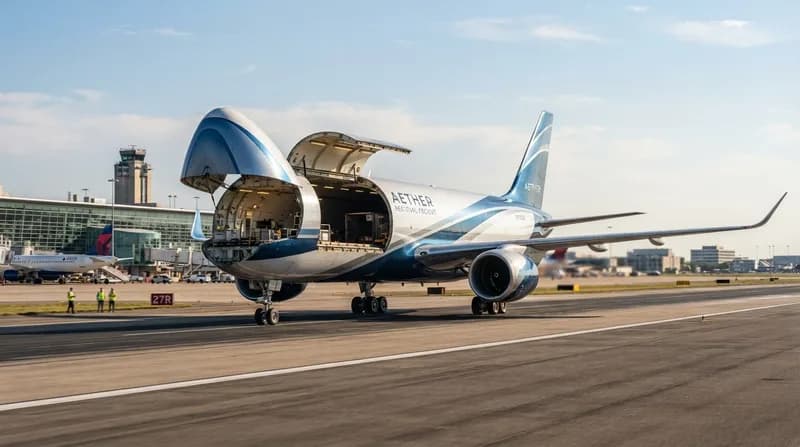
Taking to the Skies: The A350F Debut
The aerospace industry witnessed a significant milestone this week as the Airbus A350F successfully completed its maiden voyage over Toulouse, France. The freighter, which spent four hours and ten minutes in the air, reached an altitude of 25,000 feet, marking a successful start to the extensive certification process required for commercial service. With 115 orders already on the books, the aircraft is positioned to become a cornerstone of global air freight operations.
Building upon the legacy of the A350 passenger platform, the A350F is engineered to bridge the gap between mid-range haulers and the specialized oversized cargo jets of the past. By leveraging the advanced aerodynamics and fuel efficiency of the A350, Airbus aims to offer a more sustainable and cost-effective alternative to older, fuel-hungry freighter fleets currently dominating the skies.
Engineering Efficiency and Capacity
The A350F is a performance powerhouse, boasting a payload capacity of 109 tonnes. This represents a massive leap in capability compared to the Airbus A330F, which handles 64 tonnes. While it sits slightly below the total capacity of competitors like the Boeing 777F, Airbus emphasizes that superior fuel efficiency and lower operating costs make the A350F a more attractive long-term investment for logistics providers and global freight carriers.
Perhaps the most defining feature of the aircraft is its colossal 4.3-meter main cargo door. This structural achievement allows for the loading of massive, time-sensitive hardware directly into the fuselage. Airbus specifically notes that the aperture is wide enough to accommodate turbofan engines, high-density server racks for massive data centers, and specialized machinery required for semiconductor chip fabrication, positioning this freighter as a critical link in the modern technology supply chain.
Context and Future Implications
The introduction of the A350F arrives at a pivotal moment for global logistics. As older airframes like the Boeing 747 and the Antonov An-124 age out of service, the industry is searching for modern, efficient replacements capable of handling specialized industrial equipment. While the A350F is not designed for the extreme 'outsized' loads that require nose-loading, its efficiency and massive side-loading capability address the majority of high-value cargo requirements.
- Payload Capacity: 109 tonnes, offering a major upgrade over existing A330 platforms.
- Door Design: A 4.3-meter wide door designed for efficient loading of engines and large-scale tech hardware.
- Market Impact: 115 firm orders indicate strong demand for a more efficient, modern long-haul freighter.
- Sustainability: Lower fuel burn compared to legacy freighters, aligning with current industry efforts to reduce the carbon footprint of air logistics.
As Airbus moves forward with the second prototype and the subsequent hundreds of hours of test flights, the A350F stands as a testament to the evolution of aviation hardware. By focusing on modular, high-value cargo capacity, Airbus is not just flying freight; it is facilitating the movement of the physical infrastructure that powers the global digital economy.