Revolutionizing AI Inference on Sapphire Rapids
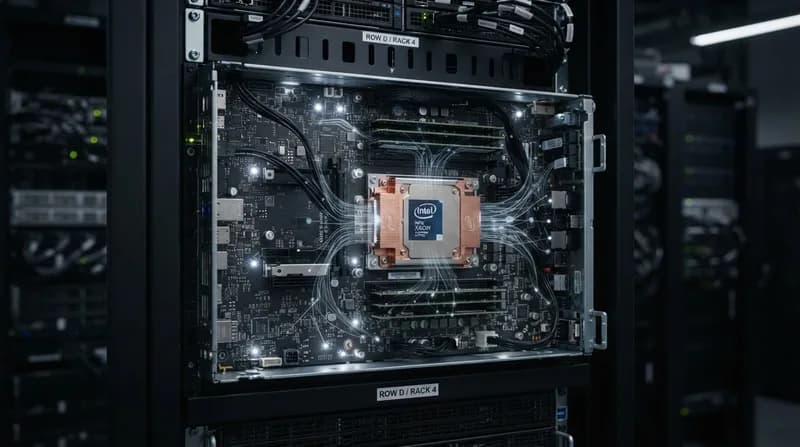
The landscape for running generative AI models is shifting. While high-end GPUs have traditionally dominated the conversation, recent breakthroughs in software optimization are proving that modern server-grade CPUs—specifically Intel’s latest Xeon processors, codenamed Sapphire Rapids—are capable of handling complex AI workloads with remarkable efficiency. By leveraging a combination of specialized toolkits and system-level tuning, developers can achieve dramatic reductions in image generation latency without the need for specialized graphics hardware.
Using the Amazon EC2 r7iz instance family, which features the Sapphire Rapids architecture, researchers have demonstrated that a vanilla Stable Diffusion pipeline can be transformed from a slow, multi-second process into a snappy tool suitable for production environments. Through a layered approach of software integration and hardware-specific instructions, the gap between standard CPU inference and high-performance AI generation is rapidly closing.
The Power of OpenVINO and Optimum Intel
The most immediate gains in performance come from integrating the Optimum Intel library and the OpenVINO toolkit. By replacing standard pipeline configurations with OpenVINO-optimized variants, developers can achieve an automatic 2x speedup. The magic lies in OpenVINO’s ability to convert standard models into highly efficient formats and optimize them for the bfloat16 data type on the fly.
Beyond basic optimization, fixed-resolution shaping provides an additional massive boost. By constraining the pipeline to a specific output resolution (such as 512x512 pixels), the system avoids the overhead of dynamic shape calculation. This adjustment can result in an additional 3.5x improvement in performance, bringing latency down to approximately 4.7 seconds per image generation—a feat that was unthinkable on older CPU generations.
System-Level Tuning and Memory Efficiency
Because Stable Diffusion models are memory-intensive, low-level system optimizations play a critical role in unlocking total throughput. By swapping out standard memory allocation for high-performance libraries like jemalloc, developers can significantly improve memory operations and parallelization across Xeon cores. When combined with tools like numactl to pin processes to specific cores, the system avoids the costly performance penalty of thread migration and context switching.
Furthermore, implementing Intel’s OpenMP Runtime libraries allows for better management of parallel processing tasks. These optimizations alone can yield a 3x speedup on a 32-core Xeon system, proving that hardware utilization is just as important as the model architecture itself.
Leveraging Advanced Matrix Extensions (AMX)
For developers seeking the peak of performance, the Intel Extension for PyTorch (IPEX) is essential. By enabling AVX-512 VNNI and Advanced Matrix Extensions (AMX), the processor can perform intensive matrix multiplications at the hardware level. Converting models to a 'channels-last' memory format and utilizing JIT (Just-In-Time) compilation ensures that the CPU hardware is fully saturated with the computational load.
When combined with the DPMSolverMultistepScheduler—which optimizes the denoising process to require fewer steps without sacrificing quality—the total inference time can drop to just over 5 seconds. This represents a staggering 6.5x performance improvement over baseline CPU benchmarks, moving the technology into a space where it can realistically support commercial applications in marketing, content generation, and synthetic data production.