The Evolution of Unified Segmentation
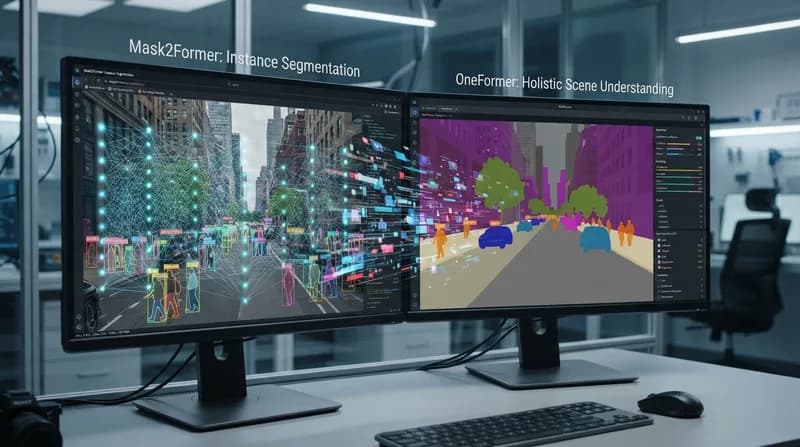
The field of computer vision has long been fractured by specialized models designed for singular tasks. Traditionally, image segmentation required distinct architectures to identify semantic segments, instance boundaries, or panoptic scenes. The emergence of Mask2Former and OneFormer marks a paradigm shift toward universal architectures, allowing a single model to perform all three segmentation tasks with high precision and streamlined efficiency.
Understanding the Architectural Shift
Mask2Former introduced a breakthrough approach by treating image segmentation as a mask classification problem. By utilizing a transformer-based decoder and a set of learnable query embeddings, the model can predict a collection of binary masks alongside their associated categories. This replaces the complex, task-specific heads that previously hindered real-time performance and architectural simplicity. The resulting framework provides a cleaner, more robust way to interpret visual data.
The Role of OneFormer
Building upon the foundational success of Mask2Former, OneFormer further optimizes the pipeline by introducing a multi-task training strategy. It employs a query-based approach that unifies the internal representation of different segmentation types. By training on a diverse set of datasets, OneFormer learns to distinguish between 'stuff' (amorphous regions like sky or grass) and 'things' (distinct objects like cars or people) within a unified output format.
Why It Matters
- Computational Efficiency: Reducing the number of distinct models required for deployment saves valuable GPU overhead.
- Interoperability: These models enable faster development cycles by providing a single API for various visual identification requirements.
- Performance Gains: Unified transformers often leverage cross-task learning, allowing the model to perform better on semantic segmentation by utilizing knowledge learned from instance-level tasks.
For developers and AI researchers, these tools signify the transition toward 'foundation models' for vision, where monolithic, highly capable architectures eventually replace the fragmented landscape of narrow-purpose AI vision tools.