A Record-Breaking Cultural Moment
The release of Grand Theft Auto VI (GTA VI) has arrived not just as a video game launch, but as a watershed moment for modern entertainment. With a staggering $3.79 billion generated on its first day, the title has eclipsed the opening earnings of blockbuster titans like Avengers: Endgame and high-profile cultural phenomena like Taylor Swift’s Eras Tour. Achieving the status of the highest-rated game in Metacritic’s history, the title serves as a massive testament to the power of long-term creative dedication in an era increasingly dominated by rapid, AI-driven output.
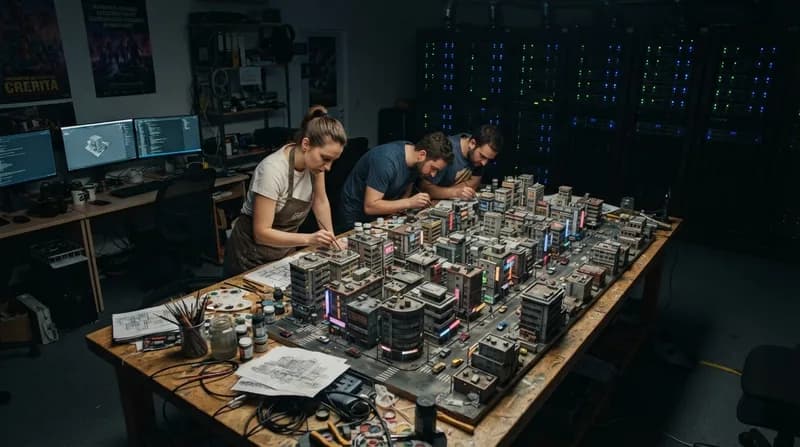
For fans who waited over a decade for this installment, the game offers a level of immersion that feels increasingly rare. While the tech industry fixates on the promise of generative AI to speed up development cycles and reduce overhead, Rockstar Games took the opposite approach. By employing roughly 5,000 individuals over a 13-year development window, the studio ignored the modern siren song of the 'Year of Efficiency' to deliver a product defined by its meticulous, human-led construction.
The Paradox of Productive Inefficiency
The success of GTA VI highlights a fundamental tension in the current tech landscape. As AI labs like Anthropic celebrate record-breaking IPOs based on the premise of automating human labor, Rockstar’s latest hit relies on the very 'inefficiencies' that investors often seek to eliminate. The creation of Vice City involved thousands of developers who spent years iterating, deleting, and refining their work. This process of creative 'deletion'—the expensive, time-consuming effort to remove what doesn't work to make room for a masterpiece—is the antithesis of the prompt-and-output model championed by LLM providers.
While industry leaders like Elon Musk suggest that AI could eventually replace the traditional development pipeline by predicting user preferences and generating custom worlds on the fly, the reception of GTA VI suggests a different reality. Players are not just looking for content; they are looking for intent. Every one of the 30,000 unique non-playable characters in the game carries a level of craftsmanship that current generative AI tools struggle to replicate with the same consistency and emotional resonance.
Why It Matters: The Future of Entertainment
The juxtaposition between the Anthropic IPO and the release of GTA VI has sparked a debate about the trajectory of the arts. As software tools like Google’s Project Genie allow for the creation of 3D worlds from text prompts, the industry is left wondering if the era of the 'human-crafted' blockbuster is coming to an end. However, the sheer scale of the GTA VI phenomenon suggests that audiences still crave the feeling of a world that is cohesive, purposeful, and painstakingly realized.
- Human-Led Curation: Unlike AI-generated environments, every inch of Vice City was intentionally designed, creating a monocultural event that social media algorithms struggle to replicate.
- The Cost of Quality: Mastery requires cycles of failure and iteration. The 13-year development cycle allowed Rockstar to refine mechanics until they achieved a standard that purely automated tools currently lack.
- A Shift in Fantasy: Interestingly, the core draw of the game has shifted from pure criminal role-playing to a slower appreciation of a dense, interactive world, proving that users value deep, intentional exploration over endless, procedurally generated noise.
Ultimately, GTA VI serves as a stark reminder that in the rush to automate the creative process, humanity may risk losing the very qualities that make a product truly iconic. Whether this will be the last game of its kind remains to be seen, but for now, it stands as a formidable rebuttal to the idea that speed is the most important metric in digital creation.