The Future of Physical AI Safety
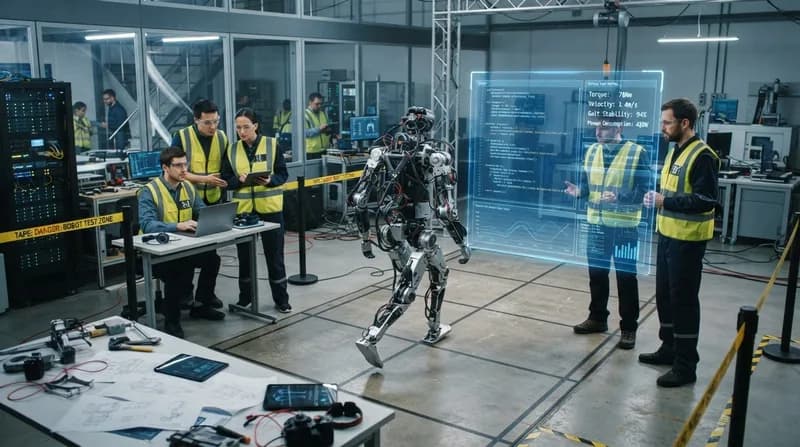
As artificial intelligence transitions from large language models confined to servers to physical entities like autonomous vehicles and warehouse robots, the stakes for system failure have shifted from data hallucinations to real-world consequences. Laplace Intelligence, an Ann Arbor-based startup, is addressing this precarious transition by developing automated red-teaming platforms. The company’s core mission is to stress-test physical AI systems by intentionally attempting to force them into failure states before they ever encounter the complexities of an uncontrolled environment.
Founded by CEO Howie Sun and Chief Scientist Henry Liu, who transitioned their academic research from the University of Michigan into a commercial enterprise, Laplace aims to create a verifiable foundation of evidence. This data is intended to provide a trusted baseline for insurers, regulators, and customers, ensuring that as we integrate robotics into daily life, we have a standardized way to measure and mitigate operational risks.
How Laplace’s Simulation Engine Works
At the center of Laplace’s technology is a high-fidelity simulation engine built upon Nvidia’s Cosmos platform. Unlike static simulations that merely replay recorded data, the Laplace environment is dynamic and interactive. By pulling real-world geospatial data and live traffic information from sources like TomTom, the system reconstructs environments—such as specific street intersections or highway segments—to scale. These environments are not passive backdrops; they feature agents that behave with realistic intent, ensuring that the AI being tested is interacting with other entities that respond to its actions in real-time.
The真正 differentiator lies in the company’s use of AI to generate corner cases. Traditionally, autonomous vehicle testing relies heavily on human-coded scenarios or synthetic replays of past accidents. Laplace automates this process by deploying its own AI agents to proactively search for vulnerabilities. By feeding these agents information from news reports, police accident logs, and various historical data sets, the system can autonomously conceive and execute rare, high-risk scenarios to see how a robot or vehicle responds under extreme pressure.
Market Outlook and Competitive Landscape
Laplace is already proving the utility of its platform, currently securing contracts with industry players including autonomous trucking firm Bot Auto and major Japanese automotive manufacturers. Furthermore, the company is involved in a collaborative smart-city pilot for San Jose, California, in partnership with Nvidia and T-Mobile. This pilot serves as a proving ground for traffic operations management, demonstrating that the platform’s utility extends beyond vehicle testing into broader municipal infrastructure.
While the firm faces stiff competition from well-capitalized incumbents like Applied Intuition, the leadership team remains focused on their unique paradigm: AI testing AI. By removing humans from the initial loop of scenario creation and focusing on dynamic, interactive simulation, Laplace believes it is building a technological moat that will define the standard for physical AI safety. As the industry grapples with the relative lack of training data for generalized robotics, the ability to generate and test against unknown edge cases will likely become a critical requirement for any commercial deployment.