A New Era for the MacBook Pro
The tech landscape shifted last October when Apple unveiled its latest MacBook Pro, marking a historic milestone: the debut of a touchscreen display in the MacBook lineup. Featuring the innovative PROLED XDR screen, this device utilizes tandem OLED technology, which stacks two layers of organic light-emitting pixels. By eliminating the need for a traditional backlight, the display achieves deeper blacks and improved longevity. Under microscopic examination, it is clear that Apple has engineered the blue subpixels to be significantly larger than their red and green counterparts, a strategic design choice intended to mitigate the natural degradation of blue OLED materials over time.
Repairability: The Good and the Bad
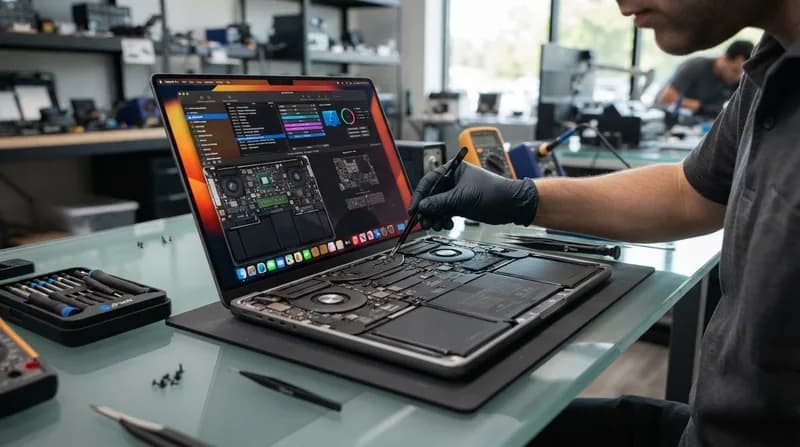
As with any major hardware launch, industry experts have subjected the new MacBook Pro to a rigorous teardown to gauge its long-term viability and ease of service. The results present a nuanced picture for consumers and professional repair technicians alike. On the positive side, the device marks a step forward in modular design. The display lid assembly is remarkably straightforward to remove, utilizing a three-screw hinge system and streamlined cable brackets that mirror the efficiency of previous 14-inch M6 models.
Furthermore, Apple’s software-side advancements show promise. The integrated Repair Assistant tool performed admirably during system board swaps. When pairing a touchscreen from one unit with a separate logic board, the system correctly identified critical components like the battery, display, and Touch ID sensor without requiring complex manual calibration. This level of software integration is a welcome evolution for hardware serviceability.
The Hurdles of Hardware Maintenance
Despite these improvements, the MacBook Pro remains a device that resists granular repair. Attempts to separate the display panel from the lid assembly often result in the delamination of the glass and catastrophic cracking of the underlying OLED and touch layers. This effectively means that for the end user, a single crack often necessitates a complete lid replacement rather than a simple panel swap.
The internal architecture beneath the bottom cover reveals that while some parts have improved, historical bottlenecks remain. While the MagSafe connector remains easily swappable, the USB-C ports, cooling fans, and headphone jack are still heavily obstructed by the logic board, requiring a significant disassembly process to reach. Furthermore, critical components like the HDMI port, SDXC reader, memory, and storage continue to be soldered directly to the mainboard, preventing any possibility of component-level upgrades or repairs.
Why It Matters
Ultimately, the device earned a 5 out of 10 on the standardized repairability scale. While this represents a marginal improvement over the previous M5 iteration, it highlights the ongoing tension between creating ultra-thin, high-performance hardware and ensuring that a consumer's investment can be serviced efficiently. The new illuminated Apple logo, while aesthetically pleasing, adds another layer of complexity; the LED strip is positioned behind the display panel, rendering it nearly inaccessible for repair should the lighting module fail.