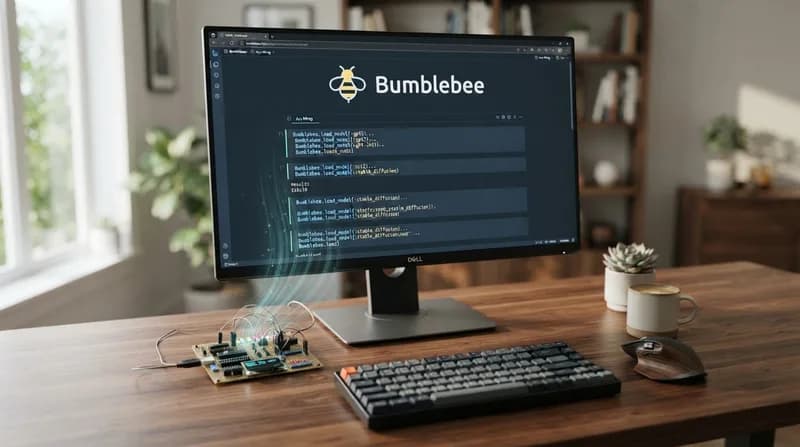
The Arrival of Bumblebee
The Elixir programming community has marked a significant milestone with the release of Bumblebee, a transformative library that brings Hugging Face Transformers to the Elixir language. By implementing pre-trained neural network architectures in pure Elixir, developers can now seamlessly integrate cutting-edge machine learning capabilities—ranging from text generation with GPT-2 to image synthesis with Stable Diffusion—directly into their existing software stacks.
This integration is not merely a wrapper; it is a full-featured implementation designed to exploit the inherent strengths of the Erlang Virtual Machine (BEAM). Because Elixir excels at concurrency and distributed systems, developers can now serve these sophisticated models within Phoenix web applications, incorporate them into robust data pipelines via Broadway, or even deploy them on Nerves-based embedded systems without relying on bulky external microservices or third-party dependencies. Models compiled through Bumblebee are fully optimized for both CPU and GPU execution.
Streamlined Development with Livebook
To ensure accessibility for developers, the team behind Livebook, a popular computational notebook platform for Elixir, has introduced "Smart cells." This feature drastically lowers the barrier to entry by allowing users to scaffold complex neural network tasks in as few as three clicks. By leveraging these intelligent snippets, developers can bypass the tedious boilerplate code traditionally associated with model deployment and focus instead on the logic of their specific business use cases.
The ecosystem surrounding this launch is built upon the Numerical Elixir (Nx) foundation, which has been under development for nearly two years. By utilizing Google XLA and Libtorch via the EXLA and Torchx projects, Nx provides the necessary high-performance tensor operations that power Bumblebee. This architecture ensures that the transition from a research-grade model to a production-ready application is fluid, performant, and type-safe.
Why It Matters
- Reduced Complexity: By eliminating the need for external AI microservices, companies can significantly reduce their infrastructure overhead and latency.
- Ecosystem Maturity: The addition of Axon for neural network composition, Explorer for dataframes, and now Bumblebee for model inference completes a comprehensive ML stack for Elixir.
- Scalability: Utilizing the BEAM runtime allows AI models to inherit the fault-tolerance and massive scalability that Elixir applications are known for in high-traffic environments.
Looking Toward the Future
The development team has already signaled that the roadmap for Elixir's AI capabilities extends well beyond simple inference. Future initiatives are slated to focus on model training and transfer learning, which will empower businesses to fine-tune pre-trained architectures to meet specialized requirements. Furthermore, the community is actively seeking contributions to broaden the range of supported model architectures, inviting developers to participate in everything from compiler optimization to practical model building. As it stands, the Elixir community is positioning itself to be a formidable player in the machine learning space, offering a unique, concurrent-first alternative to the standard Python-dominated AI landscape.