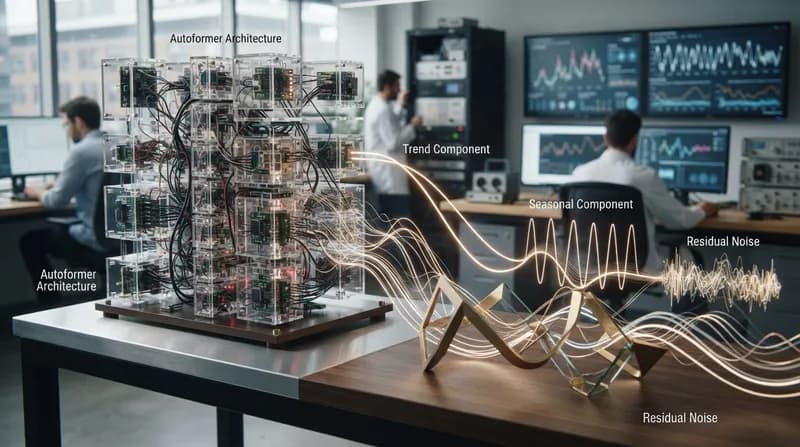
Revisiting the Transformer Paradigm
For years, the machine learning community has debated the efficacy of Transformers in time series forecasting, particularly in the shadow of simpler, linear models. However, recent benchmarks reveal that Transformer-based architectures are not only competitive but consistently outperform simpler models when measured against rigorous standards. At the center of this evolution is the Autoformer, a model that has successfully integrated complex decomposition techniques to master the intricacies of temporal data.
While recent discourse suggested that simple linear models—like the DLinear network—might surpass Transformers, empirical evidence suggests otherwise. When evaluated on complex datasets like Traffic, Electricity, and Exchange-Rate, the Autoformer demonstrates superior predictive accuracy, proving that the nuanced attention mechanisms within Transformers offer a depth of capability that basic feedforward networks cannot replicate in univariate settings.
The Anatomy of Autoformer: The Decomposition Layer
The core innovation within Autoformer is its sophisticated approach to time series decomposition. Traditional analysis often struggles to untangle the messy combination of trend, seasonality, and random noise. Autoformer addresses this by embedding a decomposition block directly into the model’s internal architecture. This allows the model to progressively extract trend-cyclical patterns while isolating seasonal variations at each layer of the encoder and decoder.
Mathematically, the layer simplifies the input series by utilizing moving averages to define the trend-cycle, then subtracting that trend to isolate the seasonal component. This method, now widely adopted by subsequent models like FEDformer and DLinear, provides a structured foundation that allows the model to focus its predictive power on meaningful signals rather than raw, noisy data.
The Autocorrelation Mechanism
Perhaps the most significant departure from the vanilla Transformer is Autoformer’s abandonment of standard point-wise self-attention in favor of an Autocorrelation mechanism. Standard attention computes weights in the time domain, which can often fail to capture the repeating periodic dependencies critical to time series. Instead, Autoformer shifts this operation to the frequency domain using the Fast Fourier Transform (FFT).
By utilizing the Wiener–Khinchin theorem, the model calculates correlations across different time lags efficiently. This approach operates at O(L log L) complexity, making it computationally lean. The "Time Delay Aggregation" process then aligns the values based on these identified periodic lags, allowing the model to perform element-wise multiplication that honors the temporal nature of the data far more effectively than traditional dot-product attention.
Why It Matters
- Performance: Autoformer consistently shows lower error metrics across varied temporal datasets compared to simple linear models.
- Architecture: The integration of frequency-domain attention proves that custom attention mechanisms are superior to generic NLP-style attention for time series.
- Interpretability: By isolating trends and seasonal patterns, the model provides clearer insights into how it arrives at its forecasts.
Ultimately, the successful deployment of Autoformer within the Hugging Face Transformers ecosystem highlights a maturation in how we handle temporal data. It confirms that as long as the architecture is tailored to the unique physical properties of time-series signals, Transformers will remain the gold standard for predictive modeling.