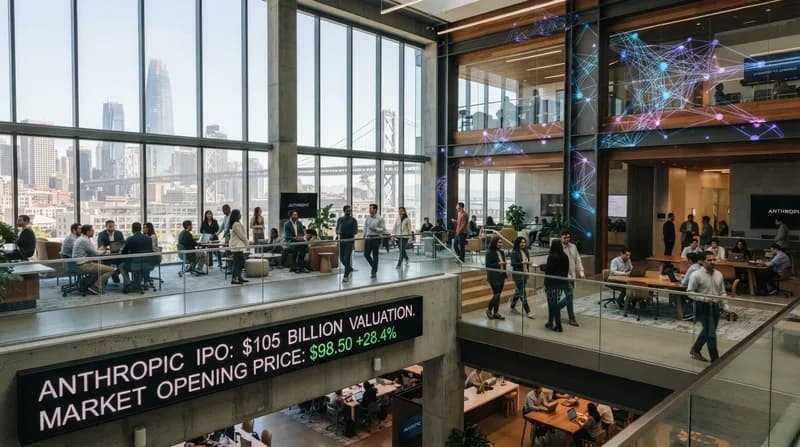
A Record-Breaking Market Debut
In a watershed moment for the artificial intelligence industry, Anthropic has officially entered the public markets, securing a staggering $81.3 billion in its initial public offering. The event has set new benchmarks for the tech sector, far eclipsing the $16 billion raised by Facebook during its own highly anticipated IPO in 2012. The final valuation and capital influx underscore the immense financial intensity required to sustain the current generation of foundation models.
As part of the offering, the company's seven founders collectively liquidated 3.4 million shares each. With the IPO price settling at $83 per share—surpassing the company's midpoint target—each founder walked away with roughly $280 million. While the scale of these personal gains is significant, Anthropic has noted that these individuals have expressed an intent to dedicate 80% of their equity to philanthropic endeavors, though these commitments remain voluntary and non-binding.
The Strategic Influence of Cloud Giants
The IPO structure revealed the deep integration between Anthropic and the traditional cloud infrastructure titans. Beyond standard Class A common stock, the company issued $26 billion in specialized, non-voting Class N shares. This tranche was absorbed by an elite roster of industry heavyweights, including Nvidia, Broadcom, Micron, Microsoft, and TSMC. Notably, the investment reinforces the tight-knit ecosystem between hardware providers and AI developers.
Ownership stakes among the major players are substantial. Google currently holds a 13.4% stake, while Amazon—leveraging the conversion of previous promissory notes—emerges with a 14.6% stake. Combined, these two cloud providers now control roughly 28% of the company, illustrating how critical cloud infrastructure has become to the survival and growth of modern AI labs.
The Multi-Trillion Dollar Infrastructure Reality
Despite the historic capital raise, the financial burden of operating at the cutting edge of AI is daunting. Anthropic disclosed that it has projected infrastructure and compute commitments totaling between $1.05 trillion and $1.08 trillion in the foreseeable future. This figure places the company’s operating requirements into an entirely new tier of industrial expenditure.
To put these numbers into context, the company faces immediate pressure to fund its operations. As of September 30, 2026, the lab requires approximately $70.7 billion to cover committed infrastructure costs over the next 12 months. Looking further ahead, the company estimates it will need to account for $451.6 billion in commitments by the end of 2030. The IPO serves as a necessary infusion to manage these mounting obligations, but it also signals that the race for AGI is becoming an exercise in capital management as much as one of scientific discovery.
Why It Matters
- Scale of Investment: The sheer size of this IPO demonstrates that the era of 'cheap' AI development is over; infrastructure is now a trillion-dollar endeavor.
- Corporate Control: The significant stakes held by Google and Amazon highlight a shift toward AI being anchored by cloud providers, potentially influencing long-term industry competition.
- The Cost of Compute: The public disclosure of trillion-dollar future commitments provides a rare look at the staggering real-world costs of training and serving large-scale AI models.