The $8.2 Billion Pivot
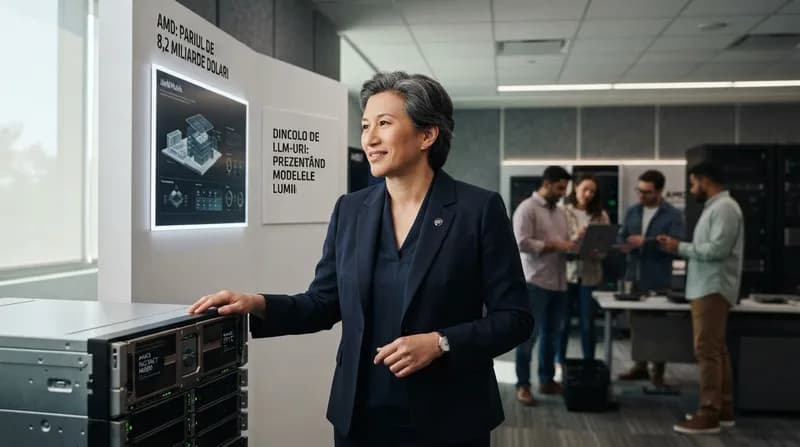
AMD has officially announced a definitive agreement to acquire World Labs, the cutting-edge spatial AI startup founded by renowned researcher Fei-Fei Li. Valued at approximately $8.2 billion in an all-stock transaction, the deal is set to reshape AMD's strategic trajectory as it looks beyond the dominance of Large Language Models (LLMs). Pending regulatory approvals, the merger is expected to close by the end of 2026, marking one of the most significant investments in AI research integration to date.
By bringing World Labs into the fold, AMD isn't just acquiring talent; it is positioning itself to influence the very architecture of future AI systems. With Fei-Fei Li joining the company as executive vice president and chief scientist, reporting directly to CEO Lisa Su, AMD is signaling a desire to move deeper into the software-hardware co-design space. This move aims to bridge the gap between pure compute power and the sophisticated intelligence required to understand the three-dimensional physical world.
Spatial Intelligence vs. Language Models
The core technology behind this acquisition—often called "world models"—represents a fundamental departure from the transformer-based architectures currently fueling the AI boom. While traditional LLMs excel at predicting the next sequence of words, world models are designed to reconstruct, simulate, and understand 3D environments. This approach treats intelligence as a spatial problem, allowing for potential breakthroughs in fields like robotics, scientific simulation, and complex digital twin environments.
For AMD, this is a calculated hedge against the possibility that LLMs have reached a plateau. Many researchers, including prominent figures like Yann LeCun, argue that language is an insufficient bedrock for "true" intelligence because it lacks the grounding of physical reality. By focusing on models that can reason over the structure and behavior of objects in space, AMD is betting that the next wave of AI utility will be found in physical interaction and environmental simulation rather than just text generation.
Why It Matters
- Hardware Optimization: By developing proprietary spatial intelligence models, AMD can tailor its next-generation GPU and NPU architectures to handle the specific, memory-intensive demands of 3D simulation rather than just token-based inference.
- Closing the Software Gap: AMD has long faced criticism regarding its software ecosystem compared to Nvidia's CUDA-dominant environment. Integrating the World Labs team provides AMD with an elite in-house development branch to create the frameworks needed to make their hardware more accessible and efficient for enterprise users.
- Strategic Diversification: The acquisition complements AMD's recent purchase of Taalas, a chip firm focused on hard-coding model weights into silicon. This suggests a two-pronged strategy: optimizing raw throughput at the silicon level while defining the advanced software models that will utilize that throughput.
Outlook and Implications
The acquisition of World Labs is a bold statement that AMD is ready to move "upstream" in the AI value chain. Rather than just acting as a hardware vendor, AMD is now positioning itself as a foundational platform provider for the next era of AI. As the industry grapples with the limitations of current generative AI, AMD’s focus on spatial reasoning could prove to be the critical differentiator needed to challenge Nvidia’s market lead. Whether these spatial models become the new gold standard for AI compute remains to be seen, but the investment confirms that AMD is betting heavily on a future where AI does more than just talk—it understands the world.