E-BUZZ ME Logo
Tech & GadgetsTechnical Deep Dive

IMF: AI Boom Helps Counteract Global Economic Slowdown Caused by Conflict

Published
IMF: AI Boom Helps Counteract Global Economic Slowdown Caused by Conflict
1 min read170 words

The Gist

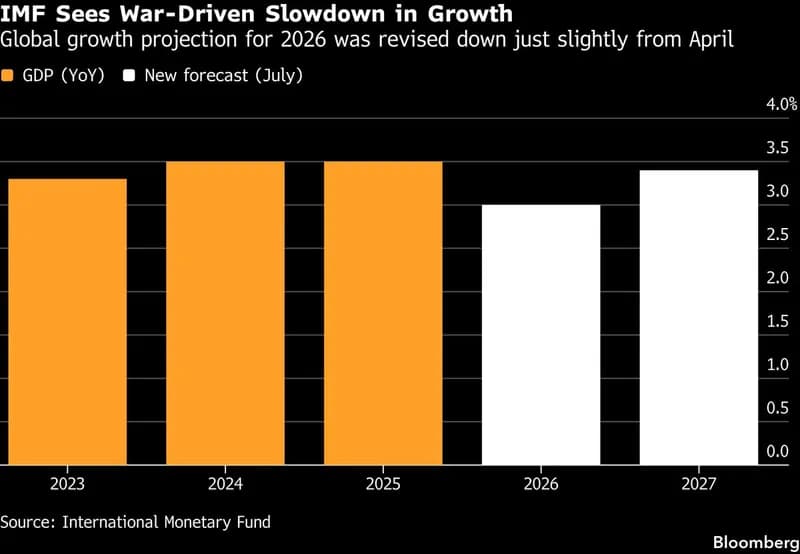
The International Monetary Fund reports that artificial intelligence growth is effectively balancing out the economic fallout from Middle Eastern conflicts, keeping global growth forecasts stable.

The International Monetary Fund (IMF) has maintained its global economic growth forecast for the current year, citing a significant surge in artificial intelligence as a primary stabilizing factor. According to the IMF, the rapid expansion and investment in AI technologies have provided a necessary economic cushion, helping to mitigate the negative impacts of ongoing conflicts in the Middle East.

A Balancing Act for Global Growth

While geopolitical tensions typically lead to downward revisions in growth projections, the productivity gains and market enthusiasm surrounding AI development have kept the global outlook largely unchanged. This technological boom is acting as a counter-weight to the disruptions in trade and energy markets caused by regional instability.

Potential Risks Remain

Despite the positive impact of AI on the current growth figures, the IMF remains cautious. The organization noted that while AI offers a boost to efficiency and innovation, it also introduces new risks to the labor market and global financial stability that must be monitored as the technology continues to integrate into the mainstream economy.


Related Stories

Semantically matched articles, ranked by topic overlap and freshness.

Asian Stock Funds Pivot to Laggards Amid AI Market Volatility
Tech & Gadgets72%

Asian Stock Funds Pivot to Laggards Amid AI Market Volatility

Major investment funds in Asia are diversifying away from volatile AI stocks, shifting capital toward banking and e-commerce sectors to mitigate risk.

Nvidia to Invest $1 Billion in Naver to Boost South Korean AI Infrastructure
Tech & Gadgets67%

Nvidia to Invest $1 Billion in Naver to Boost South Korean AI Infrastructure

Nvidia is strengthening its foothold in South Korea with a $1 billion investment in Naver Corp. to fund a massive new AI data center.

Samsung Secures Massive $200 Billion Chip Deal with Broadcom
Tech & Gadgets64%

Samsung Secures Massive $200 Billion Chip Deal with Broadcom

Samsung Electronics has landed a historic contract to manufacture chips for Broadcom as both companies look to dominate the AI infrastructure sector.

Anthropic Seeks Memory Chip Supply from SK Hynix for Custom AI Silicon
Tech & Gadgets64%

Anthropic Seeks Memory Chip Supply from SK Hynix for Custom AI Silicon

AI developer Anthropic has approached SK Hynix regarding memory chip supplies as the startup explores the development of its own semiconductors.

CATL Reports 42% Profit Surge Driven by Energy Storage Demand
Tech & Gadgets64%

CATL Reports 42% Profit Surge Driven by Energy Storage Demand

The world’s leading EV battery manufacturer, CATL, saw a significant profit increase in the first half of the year, bolstered by the rapidly expanding energy storage sector.

CFTC Issues Warning to Prediction Markets Over Self-Certification Practices
Tech & Gadgets64%

CFTC Issues Warning to Prediction Markets Over Self-Certification Practices

The Commodity Futures Trading Commission is moving to restrict how prediction markets use blanket 'self-certifications' for event-based contracts.

Massachusetts EV Owners to Earn Revenue by Selling Battery Power Back to the Grid
Electric Vehicles63%

Massachusetts EV Owners to Earn Revenue by Selling Battery Power Back to the Grid

A new initiative in Massachusetts allows electric vehicle owners to monetize their car batteries by discharging stored energy during peak demand periods.

Protect AI and Hugging Face Report: 4 Million Models Scanned for Security Risks
Artificial Intelligence62%

Protect AI and Hugging Face Report: 4 Million Models Scanned for Security Risks

Six months into their partnership, Protect AI and Hugging Face have analyzed over 4 million machine learning models to identify critical security vulnerabilities.