The Engineering Challenge
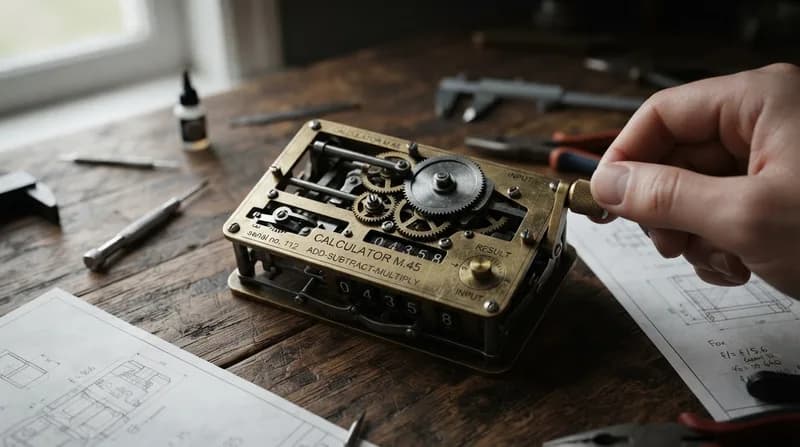
In a project that blends historical mathematics with modern manufacturing, a dedicated content creator known as 3D all Workshop has successfully designed and printed a fully functional mechanical calculator. While the concept of a mechanical calculator, such as the legendary Curta, is nothing new, translating the intricate, high-tolerance components into 3D-printed plastic is a monumental technical hurdle. The device functions as a testament to both patience and engineering, requiring over two months of development and approximately 100 design iterations to reach a state of operational reliability.
The build centers on a fundamental component from the late 17th century: the Leibniz stepped drum. Named after German mathematician Gottfried Wilhelm Leibniz, this component features a series of teeth of varying lengths. By adjusting a lever to engage specific teeth on the drum, the machine performs arithmetic operations. The 3D-printed version utilizes three of these drums, allowing for input values between 1 and 999. By repeating the addition process through a multi-wheel system, the device is capable of performing multiplication, echoing the basic logic used in high-precision vintage calculators.
Design Hurdles and Additive Manufacturing
Creating a device that relies on precise mechanical interaction is notoriously difficult when using fused deposition modeling (FDM) printers. The creator faced significant obstacles, most notably the issue of tolerances. Because 3D printers naturally produce slight variations in surface texture and dimension, the delicate gears within the calculator frequently bound or slipped. Furthermore, backlash—the unintended play between mating mechanical parts—often threw the internal drums out of sync, rendering the calculations inaccurate.
To overcome these persistent errors, the project required unconventional solutions. The final design incorporates 109 individual parts, each requiring precise calibration. The creator developed custom-printed springs and a specialized ratchet mechanism to mitigate backlash and ensure that the drums maintained their alignment during operation. Despite the frustrations of parts breaking during the iterative process and the inherent limitations of plastic filament, the finished product stands as a palm-sized marvel, even if it is currently limited to addition and multiplication operations due to extreme space constraints within the housing.
Why It Matters
This project serves as a compelling case study for the evolution of hobbyist 3D printing. It demonstrates how modern desktop hardware can now tackle complex assemblies that were once the exclusive domain of precision-machined metal manufacturing. While the calculator lacks the subtraction and division capabilities of the original, high-end, machined-aluminum Curta, it proves that with enough design ingenuity and mechanical understanding, the functional limits of consumer-grade additive manufacturing are far greater than many might assume.
For the engineering community, this build highlights the importance of mechanical compensation—using springs, ratchets, and clever geometry to mask the limitations of the underlying material. While the creator has not yet released the design files for public use, the project has already sparked significant interest from the retro-computing and maker communities, serving as an inspiration for those looking to bridge the gap between historical mechanical design and contemporary digital fabrication.